
Baby Brokers
Season 2026 Episode 7 | 54m 23sVideo has Closed Captions
Have lax laws left the for-profit adoption industry ripe for misconduct?
Have lax laws left the for-profit adoption industry ripe for misconduct? FRONTLINE and Retro Report investigate how so-called baby brokers have targeted pregnant women and families looking to adopt, and an epicenter of the problem in Utah.
Problems playing video? | Closed Captioning Feedback
Problems playing video? | Closed Captioning Feedback
Funding for FRONTLINE is provided through the support of PBS viewers and by the Corporation for Public Broadcasting. Major funding for FRONTLINE is provided by the Ford Foundation. Additional funding...
Support provided by:

Baby Brokers
Season 2026 Episode 7 | 54m 23sVideo has Closed Captions
Have lax laws left the for-profit adoption industry ripe for misconduct? FRONTLINE and Retro Report investigate how so-called baby brokers have targeted pregnant women and families looking to adopt, and an epicenter of the problem in Utah.
Problems playing video? | Closed Captioning Feedback
Where to Watch FRONTLINE
FRONTLINE is available to stream on pbs.org and the PBS app.
Buy Now
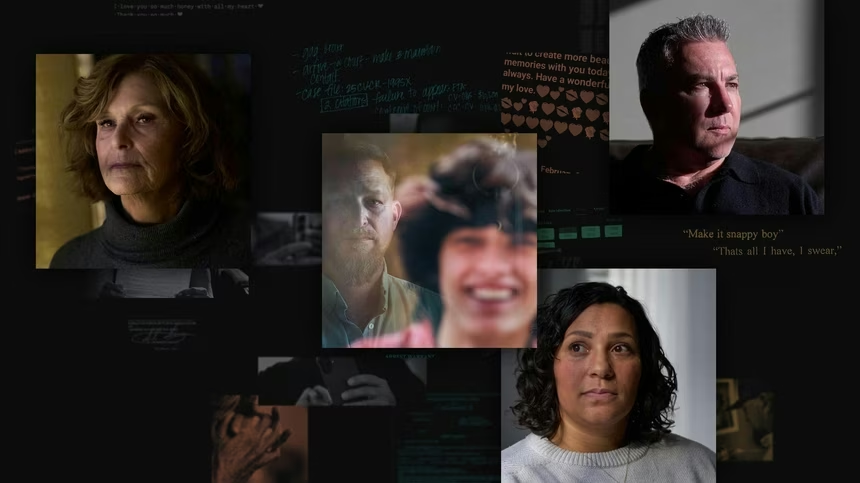
Inside the Scam
Follow scams as they unfold — and examine tactics used to manipulate victims. A collaboration between FRONTLINE and The Associated Press.Providing Support for PBS.org
Learn Moreabout PBS online sponsorship>> A lot of times these women are coming from unstable housing situations, you know, financial instability, pretty deep poverty.
>> NARRATOR: In collaboration with Retro Report, correspondent Gabrielle Glaser investigates a hidden side of the adoption industry... >> I don’t know a single adoptive parent who wants to buy a baby.
I would never want my children to feel like they were bought and sold.
>> The law says you can’t buy a baby.
That’s the law.
Okay, but can you help this birth mom?
>> NARRATOR: ...the efforts for reform... >> We have more work that we need to do in this area to try to end the exploitation that we know is occurring among these birth mothers.
>> This is not a problem that states individually can solve alone.
>> NARRATOR: ...and the impact on families.
>> Everything was just too fast.
She was reading.
She pointed.
I signed.
>> I remember walking in and there was all these pregnant women, like, sleeping on the floor.
Just being like, what have we done?
>> NARRATOR: Now on FRONTLINE, "Baby Brokers."
♪ ♪ >> A local adoption agency tells us it can take up to two years or more for a family to adopt.
>> The birth rate is down in the U.S., leaving a lot more waiting families than available infants.
>> GABRIELLE GLASER: I've been reporting and writing about adoptions in the U.S.
for years, as it's grown into a multi-billion-dollar industry, and demand has gotten so high that prospective parents outnumber infants by more than 40 to one.
>> Countries that used to adopt out thousands of orphans a year have tightened up their rules.
>> GLASER: Many states have strict laws that govern adoptions.
But over the past few years, I've been investigating a more loosely regulated corner of the industry-- where pregnant women are often lured far from their home states by so-called baby brokers, offering quick money to them, and quick adoptions to hopeful parents.
>> Utah's loose adoption laws have led the state to become a destination for adoption tourism, with pregnant women and adoptive families traveling from all over the country to come here.
>> GLASER: It's been described as "adoption tourism," and Utah is an epicenter.
♪ ♪ (keys clacking) Much of the business begins online.
>> That first page is going to be all the paid ads that are targeted towards that region.
So, "get paid for adoption"... geocode, Columbia, South Carolina... >> GLASER: Kelsey Vander Vliet Ranyard works for a non-profit that tracks agencies and brokers that solicit pregnant women around the country.
>> In my work, we survey what's happening in the Google advertisements.
We conduct Google searches from all over the country, from different states and regions, to understand what is popping up in women's Google searches when they look for adoption help.
>> GLASER: She had first-hand experience, as she had placed one of her own children for adoption.
>> "Choose adoption.
"Free, safe housing for you and your family.
Money for bills, food, and more."
A lot of times, these women are coming from unstable housing situations, um... you know, financial instability, pretty deep poverty.
They could live down the street from an adoption agency that's licensed in their state and can provide social services to them, but that agency is pretty unlikely to actually appear in the ads, because an overwhelming amount of those ads, those paid ads, are coming from Utah adoption agencies.
But... >> GLASER: In some cases, she said, the ads are not even directly from the agencies themselves, but from unlicensed brokers working on their behalf.
>> This is an unlicensed intermediary in Virginia, and their job is to get you to move to Utah.
Convince you to move to Utah.
Facilitate your relocation, and as soon as you arrive, you are handed off to your agency.
Typically, adoption would be finding families for children who need them.
But what private, domestic infant adoption has really become is finding children for families who want them.
And because that's been the focus, it's become incredibly transactional.
♪ ♪ >> GLASER: One woman who was drawn into this process was Tia Goins.
Her experience began back in 2018, in Michigan, after she had given birth.
She was 20 and facing homelessness as winter approached.
What gave you the idea to consider adoption?
>> I mean, I was adopted.
So that's what kind of gave me the idea, because I was adopted.
>> GLASER: So, can you walk me back through how you... you decided to look up an agency, what happened?
>> (blows nose) >> GLASER: Can you tell us what... >> I just was having all these different emotions in my head, like... I don't want to be in the shelter with her.
So, literally, the first thing that popped into my head was adoption.
So, I just looked up adoption agencies.
First thing I typed in Google search: "adoption agencies."
And the first link that popped up, I clicked the number and I called it, and a lady named Flossie Green answered.
And she told me that they would give me $1,000 if I go through with the adoption.
So, um, I told her just to give me a couple days and let me think about it, let me figure out if that's what I wanted to do.
She, she called back the next day.
>> GLASER: Within 24 hours, she said the woman from the ad, Flossie Green, had arranged for her and her three-month-old baby to be flown to Salt Lake City, where the owner of an adoption agency was waiting.
>> Hi, my name is Sandi Quick.
I am the owner, founder, and director of Brighter Adoptions.
We are a licensed child-placing agency located in Utah, and we serve women from all over the United States who are wanting to do an adoption... >> GLASER: Goins had been passed on to Sandi Quick, who brought her to a nearby restaurant, where she met a couple who'd come from out of state to adopt her baby.
But later that night, back at the hotel room, she said she began having second thoughts.
>> I just kept hearing something that just kept telling me to go back home.
"Go back, go back home, go back home."
So I called Sandi; Sandi didn't answer the phone.
So I texted her.
I'm like, "Um, I might... "I don't think I want to do this anymore.
I think I want to go back home."
And she's like, "Okay.
"I'm in labor with another mother right now.
I'll give you a call back in a second."
♪ ♪ >> GLASER: She said the call never came, and the next morning, she said Quick's agency presented her with the adoption paperwork.
>> It happened too fast-- everything was just too fast.
The lady said "I'm going to read these off," and, you know, "you sign where I point."
So she was reading.
She pointed.
I signed.
♪ ♪ >> GLASER: Once she signed, there was no turning back.
While some states give birth mothers 30 days to reconsider, even after they've placed, at the time, Utah did not.
The whole transaction took three days.
>> It hurted really bad, to go back through the same airport I came out of with a baby, without a baby.
>> GLASER: Before she left Salt Lake, she said Quick handed her an envelope with $4,000 in cash.
Back then, Utah had no limits on the amount of cash payments to birth mothers, as long as the agency said it was covering what's considered reasonable costs for pregnancy and immediate postpartum care.
>> She told me, "Try not to... try not to spend it all on one place."
Or use it wisely, that's what she told me.
"Use it wisely."
>> GLASER: We reached out to both Flossie Green and Sandi Quick, but neither of them would agree to talk to us.
Authorities have never charged them with any crimes or prevented them from operating.
When I first wrote about Tia Goins's story in 2024, Quick told me in an email that she couldn't discuss specific cases, but that her agency takes any indication of hesitation from a birth mother very seriously.
And she said they'd "never take consent from a mother who did not fully understand the ramifications."
For years after the adoption, Goins pursued the adoptive parents for contact with the child-- so much so that a court issued a restraining order.
In a statement, the adoptive mother said that her daughter is now a "bright, healthy, extraordinary little girl" and that the adoption was voluntary.
She said the adoption industry needs federal oversight and uniform standards.
♪ ♪ I spoke to dozens of people while reporting this story-- birth mothers, adoptive parents, adoptees, agency owners, government officials, and law enforcement.
And I combed through thousands of pages of adoption-related documents.
What I found was a patchwork system, where states like Utah with historically lax rules have allowed brokers and agencies to profit-- and critics say often take advantage of birth mothers and adoptive parents.
Why would adoptive parents want to come here from elsewhere to adopt?
>> A lot of times they get led here by their consultant, and the draw of it is just too good.
The idea that they could have a baby in just a few months, I think that's very attractive to desperate people.
Adoptions are easy, maybe quicker, seemingly more efficient in terms of bureaucratic red tape.
Essentially, Utah has become a location for private adoption forum shopping.
♪ ♪ >> GLASER: In recent months, the state has moved to tighten its adoption laws in response to mounting criticism from birth mothers and their advocates.
Some disillusioned adoptive parents have also been expressing concerns.
>> It's been hard to wrap my mind around what, what we played into.
I touted how beautiful our adoption, how easy our adoption was.
Of course it was easy.
Easy doesn't mean good.
So yeah, there's, you know, there's a level of guilt that I've had to work through.
>> GLASER: This woman adopted a baby in Utah in 2019.
She was steered there by a private consultant, another type of unlicensed intermediary, and started going through the process again a few years later.
>> So, this is basically what we would receive as information about a mom who's pregnant and was considering adoption.
So, this one we got in March 2022.
It says she has been here before and placed a child for adoption in February of 2020 and June of 2021.
So that's three babies in less than three years, all placing.
>> GLASER: What did this say to you?
>> I mean, she's either not receiving support to... heal, to have access to affordable health care, affordable contraceptives.
Or she's become accustomed to whatever lifestyle and support the agency's providing her, and is... being sold on doing that.
It's telling me, you know, she's very young, and it's... it feels exploitative.
I mean, she's con... she's continuing to get pregnant, give birth, and place.
>> GLASER: She told me she and her husband were so concerned about the process, they ultimately decided to adopt through an agency in their home state of Georgia.
>> By spring of 2022, my husband and I just-- I remember saying to him, "I don't think that we can adopt again in this way, because I don't think I could live with it."
>> GLASER: Many women I have spoken to who were in Utah, who once they did place, received cash payments.
>> That feels gross to me, to be handing someone a lump of cash.
The point of birth mother expenses are to provide the support she needs to have a healthy and safe pregnancy.
Not to give you $5,000 cash to go and do what, what you will.
Not to be an inducement to place your child.
How does that not end up feeling like selling a baby?
I don't know a single adoptive parent who wants to buy a baby.
I would never want my children to feel like they were bought and sold.
♪ ♪ >> GLASER: One of the reasons Utah became such an adoption hot spot is due to how agencies have used cash and housing offers as incentives for vulnerable women in other states.
Ashley Mitchell placed her own child for adoption and later became an advocate for reform.
>> I just kept getting messages and messages, and-- "you need to see this," and "have you heard about this?"
And "Do you know about this contract?"
And "Do you know about this apartment?"
>> GLASER: I met with her in 2025, when she showed us some local apartments that agencies had used to house pregnant women from out of state.
>> So... this... was the first apartment that we heard of.
I mean, look how broken down, like all the blinds and everything.
>> GLASER: Wow, yeah.
She said she'd talked to birth mothers who'd lived in these kinds of apartments, and told her that there were consequences for anyone who changed their minds about going through with an adoption.
>> If a woman wanted to parent, they would be evicted immediately.
Because if they were brought here for the sole purpose of adoption, they're not going to pay their bills anymore.
And this is like, "you carrying your baby out of the hospital, we're packing up your (bleep) in your, in your apartment."
♪ ♪ >> GLASER: Mitchell learned about a woman who'd gone through that experience.
The woman had reached out to a Facebook group of birth mothers who rallied to help her.
>> And so, I just said, "Well, let's go-- let's go get her."
This is like, crazy, this is so messed up-- I wish I was surprised that this was happening.
I wish I was... I'm very angry, but I'm just like... like, pick a day.
It's just a normal Wednesday in Utah.
Which is so messed up.
Just making sure this is the right address.
>> GLASER: We filmed as she went to see the woman at a home they'd found for her, her newborn, and two toddlers to stay in while she figured out next steps.
(door unlocking) >> Hey.
>> Hi.
>> Hey, how are you?
>> Good.
>> Good.
>> It's so nice to meet you.
>> Yes.
>> Hi, beautiful.
How are you?
(indistinct chatter, toddlers babbling) (laughs) >> Can I hold that?
I brought some gifts.
>> Okay.
It's so hurtful... >> GLASER: She'd come to Utah from a state where abortion is illegal.
She had no job, and no stable place to live.
>> I live here, I'm born and raised here.
>> Oh, really?
>> I placed my son for adoption 18 years ago.
>> Oh, okay... >> GLASER: She'd gone online looking for help and found an ad from Flossie Green, who put her in touch with Denise Garza, the owner of the Love and Light adoption agency.
>> I'm happy with her.
Like... >> GLASER: She said Garza offered her a free apartment with a playground and a pool, good medical care, and money for food and clothing.
But once she was there, she began to have second thoughts about placing the baby.
>> As my stomach got bigger, and just... my emotions were just really getting in the way, like, for me.
And, you know, at times, I felt like I was scared to say, "Hey, I don't want to do it anymore."
>> Yeah.
>> It's getting to the end, and I don't know if I owe something.
I just felt pressured all the way around.
>> Mm.
>> Like-- I just felt trapped, isolated, and I was just ready to run off and I didn't know where to go.
It just feels like I've been hit by a train several times, and... >> It's wild.
>> And it's, it's... I don't even know what to say no more.
>> I'm sorry.
>> Let's switch.
>> Trade you.
You're like... (relieved sigh) >> (laughs) >> Okay.
>> (laughing): Yeah.
I never would've thought I would be in this situation, like for real.
>> Mm.
>> Going back to square one.
>> GLASER: The woman was scheduled to fly back to her home state the next day.
>> What a (bleep) mess.
(car door slams) (seatbelt clicks) God, that's so (bleep) up.
>> GLASER: After leaving, Mitchell called us to talk about the situation.
>> Let me, um, call them real quick.
(sighs) They just make it-- there's just no way, they just make it impossible.
What the (bleep) is she supposed to do?
Lose her kid or lose her support-- like... (phone dialing out) Hey.
>> GLASER (on phone): How are you?
>> (on phone): Tell us, how did it go?
>> Uh... I mean, I-I don't-- like as good as those things go, I guess.
(laughs) I mean... She, um... (sighs) She's so... I-I'll bet... I just-- it would not-- I will just tell you it would not shock me in any way if she goes back to an agency to place.
She's got to get on an airplane tomorrow or not.
She's either going to pack up her (bleep) and get on that airplane with her new baby, or she's going to go back to the agency, because those are her two options.
♪ ♪ >> GLASER: The woman ended up returning home with her newborn.
But six weeks later, she reached back out to Denise Garza at Love and Light for help.
When I got in touch with the woman again, she told me that Garza had flown to her, arranged the adoption, and then gave her $5,000 in cash apps and gift cards.
Denise Garza wouldn't agree to an interview, but has disputed the woman's account.
I'd started reporting on her two years earlier.
Although there weren't any criminal charges, in 2018, Utah revoked her license for five years after regulators cited her for violations, including failing to provide medical information to adoptive parents, falsifying forms, and charging for medical expensives paid for by Medicaid.
At the time, she told me in an email that she was very sorry for the mistakes she'd made in the past and was committed to mothers' safe and healthy pregnancies and running her agency at the highest ethical and administrative standards.
In addition to Garza and Quick, a few other adoption agencies in Utah also regularly bring women in from out of state.
(on screen): Donna?
>> Hey, hi.
>> GLASER: Donna Pope runs one of them, and agreed to talk to me.
(on screen): Oh, is this your map you were telling me about?
>> This is the map.
And this is also... this is our wall of fame.
>> GLASER: Wow.
>> This is this year.
>> GLASER (voiceover): Her non-profit agency, Heart to Heart, arranges about 90 adoptions a year.
She said roughly a quarter of them are with out-of-state birth mothers who've traveled to Utah.
>> Every one of these has this amazing story.
>> GLASER: Some agencies here are for profit.
And I know you know about them.
Some of them have come under scrutiny.
Sandi Quick and Denise Garza, who run for-profit entities, have raised a lot of eyebrows nationally, and you are aligned with them.
How do you think some of that scrutiny reflects on the adoption industry in Utah overall?
>> Yeah, no.
And I like Sandi and I like Denise.
I, I think they're wonderful people and I, I care about them a lot.
Um... Since it's become more scrutinized here, we've, we've increased our conversations with each other and, um... we have talked a little bit more about, well, why are you choosing to do it that way?
Why are you choosing to do it this way?
Um... I don't feel like I'm in a position to tell people how to run their business.
I, I don't feel like that is my job.
Um, I certainly am very-- as you can tell-- vocal about some of the principles that I think are important.
One is that you treat women with dignity, with respect, and empower them and try to make sure that you follow what their needs are and try to fulfill them.
>> GLASER: Pope has never had any legal or regulatory sanctions that stopped her from operating her adoption business.
And as for out-of-state adoptions specifically, she said they fulfill an important need.
>> This population of women are oftentimes extremely vulnerable.
They don't have a lot of power.
If they need to get up and move, let them get up and move.
If they need additional help from someone else that's not their neighbor, get them additional help from someone else that's not their neighbor.
Empower them to get the services they need, wherever that might be.
>> GLASER: But one thing I learned was that sometimes women get cash payments.
What do you think of that, and do you think that can be seen as coercive?
>> Yeah, no, I think that's something people bring up.
Let-- let, let's... first of all, we can go to the law part about it.
The, the law says you can't buy a baby.
That's the law.
Okay, but, can you help this birth mom?
Well, sure.
Help her.
Well, how?
How can I help her?
Well, help her with her pregnancy-related expenses.
That would include housing, clothing, um... her phone, they always need a phone.
Uh, transportation, utilities, medical care, legal care, legal help if they need counseling.
Well, that costs money.
>> GLASER: How do you make sure these payments don't function as an inducement rather than legitimate support?
>> I, I sometimes think that we are goofy in how we think about this, because some states, we say, "Don't you have an abortion."
But then we say, "But don't get any help, or it's seen as an inducement."
Well... come on, you guys.
Be fair with her.
She needs help.
We've gotta give them the ability to live during the time that they're pregnant so that they can give life to that child.
♪ ♪ >> GLASER: But there are also critics of the practice within the industry itself.
Tara Romney Barber is program director for a non-profit child welfare organization that provides family services, including a small number of adoptions-- just two last year.
They don't work with mothers from out of state, and they charge about $20,000-- a fraction of the more than $80,000 that some agencies have charged.
>> Yeah, I mean, Utah is known as being a family-friendly state.
That is a reputation I think my state really enjoys having, and we hold that.
That's a core value for our state.
And in that, we want to make sure that families can be created in all kinds of ways, adoption being one of those.
>> GLASER: So, you have recently been very vocal about your concerns surrounding what's happening today in Utah adoptions.
Can you lay out for us what's happening and why you have raised your voice?
>> Yeah.
One of the things that I've been really concerned about is we were getting reports from community partners about the increase in the number of adoptions they were seeing, where the adoptive parents and the birth parents were coming to Utah from other states solely for the purpose of the adoption, and then they would both, you know, fly back or go back to wherever they came from.
And the partner had some real concerns about the things that she was seeing as she was talking to me about it.
And they were matching up with some of the things that I was learning about what was happening in the adoption world.
And, um, the more... you know, thinking about it, was what can we do to maybe have our voices heard that we don't necessarily agree with that type of practice, that it can be predatory in our opinion, my opinion, and that people deserve to be protected throughout what can be a really vulnerable process of adoption.
>> GLASER: She told me about one local hospital where there were as many as three adoptions a week-- all of them with impoverished women from out of state.
>> Why are we recruiting women in another state to come to Utah solely for the purpose of adoption?
And why are we bringing in adoptive families who are not residents of Utah to Utah solely for the purpose of this placement and this adoption?
And I... it makes me go, well, why?
Why aren't we doing these in their home states or where they are?
Because what I think is, is when you remove a woman from her... her safety nets, whether she has friends or family in that home state, whether there are social supports or a job that she has there, if we're flying her to Utah, she is removed from all of those things.
In my opinion, that creates a higher level of vulnerability and a like... more... a higher chance of likelihood that that woman could be preyed upon in a vulnerable way or pressured to make a plan for adoption.
And, um, that doesn't sit right for me, because I-- what I know is that there are ethical adoption agencies and ethical adoption services available in all 50 of our states, and that a woman could receive all of the services that she's provided in Utah but in her home state, where she's not removed from kind of her own natural support system.
I think when women come from out of state, they don't always know what their rights are and feel like, could maybe potentially feel like, "Well, they've paid "for my medical expenses, they've paid for my housing.
I'm going to have to pay that back if I don't place."
That can feel coercive.
>> GLASER: A hospital employee eventually became so concerned that she wrote a report to the Utah Attorney General's Office.
In it, the employee named Denise Garza and Sandi Quick as the adoption providers and said that many of the women had mental health challenges.
Several told staff they felt pressured to sign the adoption paperwork; in one instance, twins were separated.
Ashley Mitchell saw the report and was hearing similar accounts from birth mothers themselves.
>> I think the most shocking thing that I have learned is how the women are being treated.
Because the narrative of adoption and the advertisements and the language on the websites completely contradict what we're hearing.
It floored me to see how that was actually being played out.
And that there was nothing supportive or beautiful or helpful in that at all.
>> GLASER: The hospital employee's report was given to the Utah state legislature.
>> Next up on our agenda, we are going to hear about adoption tourism.
Representative Hall, if you want to come up.
>> Thank you, Chair Gricius, appreciate you and thank you... >> GLASER: Which convened hearings in the summer and fall of 2025.
>> We are an adoption-friendly state and we want to protect that.
But we also want the practice of adoption to be ethical for all the parties involved, so thank you again for your attention to this matter.
>> GLASER: In response to the mounting concerns, the legislature was considering new laws that would give mothers 72 hours to revoke consent, require all agencies to be registered as non-profits and disclose where they are licensed, and guarantee birth mothers mental health therapy.
Among the adoption providers who testified was Sandi Quick, who defended her practices.
>> There's been negative media stories, um, that specifically named me and my agency, and I was not allowed to speak on those because of confidentiality.
We never once, um, did anything wrong, or anything unethical or anything illegal.
I'm still in business, and I'm still not kidnapping children, and I'm still helping birth mothers.
And I hope that I get to continue doing so.
>> GLASER: After one of the hearings, I tried to speak to Sandi Quick, who was in the corridor with Denise Garza and Donna Pope.
I'm here from PBS's "FRONTLINE" and I'm just wondering if you'd have a moment now?
>> No, I don't, I don't, I don't owe PBS anything.
And I don't have to answer to anybody except the office of licensing and my current clients.
♪ ♪ >> GLASER: By March 2026, the legislature would pass the proposed adoption reforms, though they left in place a controversial policy that makes it hard to undo adoptions even in cases of alleged fraud.
Not long afterwards, I met a couple from Tennessee who'd been working with Sandi Quick.
They said they'd paid her $45,000 of the total $78,000 cost of the adoption.
>> This money that you came up with, $45,000, most people don't just have that lying around.
How did you come up with that?
>> Um, so we had... ...taken out a home equity line of credit, um, because we knew there was going to be some costs upfront that we would have to, you know, have to pay to the adoption agency.
We had also, uh, several years ago, we had bought a piece of land that we had thought we were going to use.
So we ended up selling that land.
>> GLASER: How many acres of land did you sell?
>> It was about three-and-a-half acres.
>> GLASER: Three-and-a-half acres.
>> We looked at it, as like giving up one dream for another.
>> GLASER: So, you sent this in one lump sum.
Did you ever get any itemization for it?
Was there ever any, were there ever any receipts that were provided to you?
>> No.
We received nothing like that.
>> GLASER: Under the law, adoption expenses are supposed to be documented and submitted to a court.
But a state audit found that Quick didn't submit expense reports in a timely manner for roughly 75 percent of her adoptions between 2024 and 2025.
The Tennessee couple said they'd picked out a name for their baby and were preparing for her arrival when they got an email informing them that Sandi Quick was closing her agency.
>> We get the email and there's, like, immediate panic.
I remember going, like, hot, my entire body got hot.
Um, and I immediately called her.
I immediately sent a text message, and I emailed and said, "Where is our money?"
You know, "You're not... "We are paying for services at the end of the day, and you are failing to render those services to us."
>> And we were like, "Where's, where's the birth mother?
And where's our baby?"
Like... >> Yeah.
Right.
>> "Have you transferred her to another agency?
What, what's going on there?"
And we got no reply.
>> Mm-hmm.
>> GLASER: In her email, Quick cited what she called the "changed" legal landscape.
The couple, along with several other families, still haven't gotten their money back, and have filed complaints with the state attorney general's office.
>> This is something you read about on... on the new... on the news.
Like, there's news articles, something you read about in a book or you see on TV, and it's happening to us.
And that is... that's crazy.
>> You know, you never think it's going to happen to you.
>> Crazy.
>> Yeah.
>> You feel, you know, taken advantage of.
You feel embarrassed.
You feel, um, ashamed, like, you feel all these things.
Um, but it was all out of our control.
And that's what's, like, the biggest thing.
>> GLASER: For years, many families went overseas to adopt children.
Hundreds of thousands of babies were brought to the U.S.
before scandals largely shut that practice down by the early 2000s.
But the demand for babies continued, and an adoption attorney in Arizona found another way to fulfill it-- bringing pregnant women into the U.S., and matching them with American families.
>> Hello, my name is Paul Petersen.
Welcome to our website.
Perhaps one of the most important decisions you will make is who you will trust to guide you through your adoption journey.
I am confident that I can be that person.
>> GLASER: Paul Peterson spent two years as a Mormon missionary in the Marshall Islands, before becoming a lawyer and starting an adoption business in 2005, bringing birth mothers from the islands to the U.S.
He expanded into Arkansas and Utah, where there were fewer hurdles in the adoption process.
Dan and Rachel Christensen live south of Salt Lake City.
They hired Petersen in 2018 to help them adopt a baby.
>> We had never done this before, so we didn't know how it worked.
I had a friend who had just adopted a little boy.
So I reached out to her and she connected me with Paul.
>> And then we were thinking, okay, you know, it's probably going to be like a year, year and a half, two years.
>> Two years, you know.
And then it was... >> Three weeks?
We got an email at 10:30 at night, and it just said in the subject line, "you've been matched."
>> And then at the very bottom was his account routing number to send... >> To send... >> $24,000.
>> $24,000 in, like, a couple of days.
>> It was very strange.
>> Very strange.
But you're not going to turn down a baby.
>> GLASER: Petersen had matched them with a birth mother named Telma who he had brought to Utah from the Marshall Islands.
They went to meet her at a local restaurant.
>> I remember just being like, "Are you freezing?"
Because she's wearing, like, a muumuu and flip flops, and it was, like, February.
>> And it was snowing.
>> And we're like what is...?
>> Why doesn't she have warm clothes?
>> Like, what's our money doing?
>> GLASER: Soon after meeting Telma, Rachel went to a prenatal appointment with her.
>> The doctor wanted to do an ultrasound.
And she said, "We need to take this baby because he's going to be stillborn."
>> It was so scary.
>> We had been told that she's been getting medical care... ...all along the way.
>> You know, once... once that was kind of called into question with this being her first prenatal visit, then we're like... "I wonder what else isn't, like, being done properly?"
>> GLASER: Telma was induced the following day.
She gave birth to a boy the Christensens named Kai.
A few days later, they went to the house where Telma was staying.
>> I remember walking in, and there was all these pregnant women, like, sleeping on a floor.
I don't know how Dan felt, but I was like... This is like a baby mill.
>> Yeah.
>> Like, you would have a puppy mill.
That's what it felt like.
And, um, just being like... what have we done?
Like, what is this?
♪ ♪ >> GLASER: The Christiansens told Utah authorities about what had happened.
>> We identified about 60 birth mothers that had come... come here.
I can just reach in there and pull out any of these and there's going to be a picture, or a passport.
And this is just the Utah one... related ones.
>> GLASER: Mick Spilker is an investigator at the Utah Attorney General's Office.
At the time of the Christiansens' experience, he had already been looking into Petersen after a complaint from a staff member at a local hospital.
>> We had received a call indicating some concerns about the numbers of Marshallese women that have been giving birth at their hospital.
And then, a few months later, another hospital called.
One particular social worker had spoken with the birth mothers through a translator and found out that some of them really didn't know what was going on.
>> GLASER: All of the women were from the Marshall Islands, all were placing their babies for adoption, and almost all of them had listed the same address, and the same name-- Paul Petersen-- on their paperwork.
Petersen eventually moved his operation to duplex apartments across town.
>> It's going to be up here on the left, just on this side.
>> GLASER: And Spilker set up surveillance there.
♪ ♪ >> We started subpoenaing some records, hospital records, bank records, email, social media.
We, we started just getting everything.
>> GLASER: The investigation expanded to other states, and ended up detailing a multi-million-dollar operation using unlicensed middlemen to recruit pregnant Marshallese women with promises of money and a better life for their children.
>> (clears throat) All right, it is August 14, 2019, 3:02 P.M.
We're in the Marshall Islands AG's office.
>> GLASER: In 2019, Spilker and a team of investigators traveled to the Marshall Islands to interview some of the birth mothers.
>> Did anybody offer her any money to go to the United States?
>> Mm-hm, yes.
>> Okay, how much?
>> (speaking Marshallese) It was supposed to be 3,000.
>> GLASER: Some of the women said the full amount they were promised never materialized.
And they said they had no ongoing relationships with their children, though they were told that they would.
>> Are you in contact with the baby's family?
>> (speaking Marshallese) >> No, I kept on calling them, but they're not answering my call.
>> GLASER: Petersen appeared to be taking advantage of the fact that Marshallese culture encourages extended families to raise children together.
>> Did you understand what you were doing when you were doing the adoption as far as surrendering your parental rights?
>> I did not understand.
>> Had you known what those papers were meaning, would you have gone through with the adoption?
>> I wouldn't have.
>> We felt they were just manipulated in one of the most personal and meaningful decisions of their lives.
>> GLASER: Dan Strong was part of the team that conducted the interviews.
>> I tend not to emotionalize cases very much, but it was hard for me in the room speaking to people who'd given up their child and in, in some cases due to what was an incorrect understanding on their part or-- and a lie, I think, on the... Paul Petersen's part, or at least a deliberate misleading or exploitation of this misunderstanding between our two cultures.
Um, it really made me sad.
I remember tearing up in the room as we're asking questions.
>> Yesterday around this time, agents raided Petersen's home and law office in Mesa, taking evidence from both of those locations... >> GLASER: Petersen, who was an elected county official, was arrested in October 2019, as part of an effort by federal and state investigators from Arizona, Arkansas, and Utah.
>> The commercialization of children is illegal.
And the commoditization of children is simply evil.
>> Maricopa County Assessor Paul Petersen faces 62 state and federal felony charges for allegedly running a baby mill.
>> What's kind of crazy about this case is if as a prosecutor, as a lawyer, is if you just look at what happened, you just read it, somebody just tells it to you, it's obviously horrible.
But from, like, a lawyer's perspective, it wasn't that easy to match up what happened to, um, to-to criminal charges.
I think that's one way that this type of thing kind of avoids, um, avoids capture or avoids prosecution.
♪ ♪ >> GLASER: In the end, Petersen pled guilty to a number of state and federal charges, including fraud, and because of the international nature of the scheme, human smuggling.
He's serving a sentence of more than ten years.
♪ ♪ >> I guess we couldn't deny that it was the right, the right thing to do to... ...raise questions and to... ...get, um, I guess, the attorney general's office involved.
To help as much as we could to try to bring it to an end.
>> GLASER: The Peterson case brought heightened concerns about adoptions, especially in Arkansas where he had operated, and where there is a large Marshallese population.
The state made changes to its adoption laws, but investigators continued to come across potential abuses involving pregnant Marshallese women.
>> We have more work that we need to do in this area to try to end the exploitation that we know is occurring among these birth mothers in western Arkansas.
We have to find those cases.
We have to develop the, the information to be able to prosecute them, and we have to hold those individuals accountable.
Yeah, so here's-- this is a picture I took, standing outside.
>> GLASER: Clay Fowlkes helped oversee the Peterson prosecution and was the U.S.
Attorney for the Western District of Arkansas when I sat down with him last year.
He told me he was particularly concerned about money being used as inducement for adoptions.
>> In certain circumstances, money can be paid to a pregnant woman to support them during their pregnancy.
But under no circumstances can you provide cash money to a birth mother in order to induce them and convince them to put their baby up for adoption.
And under no circumstances can someone be paid money to seek out vulnerable people.
>> As we've seen over and over again, generally, there's operation in the gray.
Ethics are... ...unfortunately, oftentimes up to interpretation.
>> GLASER: Michaela Montie had adopted Marshallese children in Arkansas.
But after having concerns about the process, she started her own non-profit agency to facilitate adoptions and provide support to birth mothers.
>> We have a couch that... (voiceover): We have at least two issues a month of families that come to us that feel like they have been preyed upon, or we get calls from hospitals saying, "We don't think this mom wants to go through with this."
>> GLASER: Montie was working with another local community advocate, Stephanie Takamaru.
At the time, they were helping a young mother who said she'd been pressured into an adoption by relatives she was living with.
>> So this is the revocation form.
>> Ms.
Amelia does not speak any English.
And so, when I met her, she's like, "Well, I had given up a, my baby back in December."
And I said, "Okay, how do you, how did you give up your baby?"
And she mentioned that she was forced.
(speaking Marshallese) >> Mm.
>> Okay.
I said, did she still want to keep fighting if that's a possibility.
>> GLASER: They were working with her on a legal petition to vacate the adoption, based on, among other things, her claim she signed paperwork she didn't understand.
(phone ringing out) >> Hey, Michaela.
So, they were both really scared about, you know, if they don't sign this, they can get the cops you know, called on them, go to jail.
>> They shouldn't be expected to be legal experts.
They're in a crisis situation, they're seeking help.
>> (speaking Marshallese): >> So Amelia did mention she's been grieving since the baby's been given away.
>> Yeah.
>> I'm sure it's so, so, so, so hard.
>> Is this-- and this is her first adoption?
>> (speaking Marshallese) >> Yeah.
>> Second baby, first adoption.
>> GLASER: Over the next year, Amelia missed a court date, and stopped communicating with Takamaru and Montie.
Her case to overturn the adoption was ultimately dropped.
>> Unfortunately, due to just the downhill impacts of homelessness, constant crisis, um... about a year into the case, when we finally had a hearing set, we lost track of her.
We could not contact her.
We didn't know where she had gone.
>> GLASER: In the summer of 2025, Michaela Montie shut down her non-profit, and now works for another larger adoption agency in Arkansas.
She says that many of the ongoing problems with adoptions could be addressed by stronger laws.
>> We have international standards that every country has to adhere to if children are coming into the United States.
Why isn't there a baseline of federal standards?
>> GLASER: To what extent do the 50 different states and the 50 different sets of laws set up a system that's ripe for exploitation?
>> I think when you have that sort of, you know, complex web of different laws and different statutes, it makes our job as investigators and prosecutors incredibly difficult.
And I think that's one thing that we could look at as a possible solution, is having one overarching set of rules and regulations that apply to adoptions that are conducted inside the United States, whether that's western Arkansas, Arizona, Utah, or anywhere else.
♪ ♪ >> GLASER: Today, lawmakers from more than a dozen states are backing a bipartisan federal adoption bill.
Congresswoman Laurel Lee is a co-sponsor.
>> GLASER: Why do you think domestic infant adoption is ripe for federal regulation?
>> Any time we see inconsistent state laws that are really operating to the detriment of families-- and this is exactly such a case-- it's an opportunity for us to look at whether there's a role for federal law.
And so while certainly we respect that adoptions fundamentally belong with states, where we see that there are some baseline standards that just aren't being met, it's a perfect opportunity for us to step in.
>> GLASER: The proposed legislation would do away with the intermediaries who work with adoptive parents and birth mothers-- the baby brokers.
>> What we really want to do is eliminate that solicitation and that marketing that's drawing those families across state lines.
And also, bringing them across state lines is one of the things that makes federal action important, that this is not a problem that states individually can solve alone.
By creating standards that will be uniform across the United States and clearly stating that this type of conduct is unlawful, we ensure that a family can't be taken from one state to another state where they will be exploited.
♪ ♪ >> Oh, no!
Oh, no, no!
>> Before having Kai, we were blessed with two biological children.
But... >> Okay, okay!
>> You know, we just knew that there was another child out there.
And that's why we chose to adopt.
But for people that have never been able to have a child, who have spent thousands of dollars on fertility treatments and all these things, like, they're so vuln... so vulnerable to, to this sort of thing.
>> Let me put this one... >> Let's put them on the grass.
I feel bad for Kai.
Like, I just feel like his story is tainted.
Because he'll grow up and he'll be able to read all these things, and it doesn't take away from how much we love him or his mom loves him or his family.
It just is, like, a time that should be really happy and exciting, is... has this dark shadow over it.
♪ ♪ >> NARRATOR: Go to pbs.org/frontline for more reporting from our partners at Retro Report.
And see our past work on international adoption.
>> I was adopted... >> I was adopted... >> I was adopted... >> ALL: ...to Sweden... >> ...in 1982.
>> NARRATOR: Visit the FRONTLINE archive where you can stream more than 300 documentaries.
Connect with FRONTLINE on Facebook and Instagram, and stream anytime on the PBS app, YouTube or pbs.org/frontline.
Captioned by Media Access Group at WGBH access.wgbh.org >> For more on this and other "FRONTLINE" programs, visit our website at pbs.org/frontline.
♪ ♪ FRONTLINE's "Baby Brokers" is available on Amazon Prime Video.
♪ ♪
Video has Closed Captions
Preview: S2026 Ep7 | 26s | Have lax laws left the for-profit adoption industry ripe for misconduct? (26s)
Providing Support for PBS.org
Learn Moreabout PBS online sponsorship New Episode
- News and Public Affairs

Top journalists deliver compelling original analysis of the hour's headlines.
 New Episode
- News and Public Affairs

Today's top journalists discuss Washington's current political events and public affairs.

 New Episode
 New Episode
 New Episode
 New Episode
 New Episode


 New Episode
Support for PBS provided by:
Funding for FRONTLINE is provided through the support of PBS viewers and by the Corporation for Public Broadcasting. Major funding for FRONTLINE is provided by the Ford Foundation. Additional funding...