
December 13, 2025 - PBS News Weekend full episode
12/13/2025 | 26m 45sVideo has Closed Captions
December 13, 2025 - PBS News Weekend full episode
December 13, 2025 - PBS News Weekend full episode
Problems playing video? | Closed Captioning Feedback
Problems playing video? | Closed Captioning Feedback
Major corporate funding for the PBS News Hour is provided by BDO, BNSF, Consumer Cellular, American Cruise Lines, and Raymond James. Funding for the PBS NewsHour Weekend is provided by...
December 13, 2025 - PBS News Weekend full episode
12/13/2025 | 26m 45sVideo has Closed Captions
December 13, 2025 - PBS News Weekend full episode
Problems playing video? | Closed Captioning Feedback
How to Watch PBS News Hour
PBS News Hour is available to stream on pbs.org and the free PBS App, available on iPhone, Apple TV, Android TV, Android smartphones, Amazon Fire TV, Amazon Fire Tablet, Roku, Samsung Smart TV, and Vizio.
Providing Support for PBS.org
Learn Moreabout PBS online sponsorshipJOHN YANG: Tonight on PBS News Weekend, President Trump vows retaliation for the killing of two US Soldiers and an American civilian interpreter ambushed in Syria.
Then how tariffs on China are making this holiday season less merry for some shoppers.
And a conversation with Beverly and Dereck Joubert about their 40 years captured dazzling images of Africa's wildlife.
WOMAN: There's always an image I'm still chasing.
I don't quite know what it is because I need to be open, but the images definitely need to be preserving and protecting wildlife in Africa.
(BREAK) JOHN YANG: Good evening.
I'm John Yang.
President Trump is vowing to avenge the deaths of two U.S.
soldiers and an American civilian interpreter in Syria.
And U.S.
officials tell PBS News the shooter had ties to ISIS and had infiltrated Syrian security forces.
The Pentagon said the two soldiers, members of the Iowa National Guard and the interpreter were ambushed by a lone gunman in the historic city of Palmyra, about 130 miles northeast of Damascus.
They were taking part in ongoing counterterrorism missions.
The gunman was killed and according to U.S.
official, he was already under investigation for his ties to ISIS.
Mr.
Trump paid tribute to the three as he left the White House this afternoon for the Army Navy football game.
DONALD TRUMP, U.S.
President: We mourn the loss.
These are great, three great people and it's just a terrible thing.
We will retaliate.
Thank you very much.
JOHN YANG: In 2019, during his first term, President Trump said ISIS and Syria had been defeated.
The U.S.
kept about 2,000 troops in eastern Syria to clamp down on south sleeper cells.
Belarus freed more than 100 prisoners after the United States said it would lift sanctions on the close ally of Russia.
Among those pardoned by Belarusian leader Alexander Lukashenko were two opposition leaders and Ales Bialiatski, who shared the 2022 Nobel Peace Prize.
Earlier, U.S.
special envoy John Coale said the United States would lift sanctions on potash fertilizer, one of the nation's most important exports.
Cole said improving U.S.-Belarusian relations could lead to more prisoner releases.
JOHN COALE, U.S.
Special Envoy to Belarus: President Lukashenko, who should get a tremendous amount of credit for this.
I think that he is moving.
He wants more normalized relationship with the United States and the west.
So we're moving in that direction.
JOHN YANG: Lukashenko is an authoritarian leader known for dealing harshly with dissidents.
Western nations have sanctioned Belarus for cracking down on human rights and for letting Russia use its territory to invade Ukraine.
And in Ukraine, an overnight barrage of Russian drone and missile attacks across the nation left more than a million people without power in the harsh winter cold.
Ukrainian President Volodymyr Zelenskyy said more than 450 Russian drone strikes and 30 missiles hit five regions of the nation.
At least two people were killed.
The assault came as Germany hosts U.S.
and Ukrainian officials to discuss President Trump's peace proposal ahead of Monday's summit with European allies.
Comedy legend Dick Van Dyke is celebrating his 100th birthday today.
Beginning in the 1960s, Van Dyke starred in television seminal sitcom the Dick Van Dyke Show on Broadway, winning a Tony Award for his performance in "Bye Bye Birdie" and in movies, including the Disney classic "Mary Poppins," where he was alongside Julie Andrews.
Last year, Van Dyke became the oldest daytime Emmy winner for a guest role on a soap opera.
In Gaza, Israel says it's killed a top Hamas commander said to be one of the last living architects of the October 7 attacks.
Gaza health authorities said the strike killed four people and wounded at least 25 others.
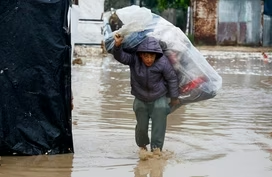
More than two months after the ceasefire agreement between Israel and Hamas, humanitarian conditions in Gaza remain dire.
The U.N.
estimates that 1.5 million people lack shelter.
Ali Rogin spoke with Jonathan Crickx of UNICEF from southern Gaza.
ALI ROGIN: Jonathan, thank you so much for joining us.
Tell us about what the conditions are like on the ground right now.
JONATHAN CRICKX, UNICEF: The conditions are catastrophic, I must say.
I've been in many, many tents in the past two days and the tents are completely flooded.
I met with tens of children.
They are -- their clothes are wet, the mattresses in the tents are completely soaked.
And those children, they are cold.
They are a huge issue when it comes to hygiene because of course, with those heavy rains, it's bringing a lot of dirty water, sewage water.
You have big pile of rubbish which are being taken away by the rains.
And we are very, very concerned, first of all, to see children getting sick.
And I met many sick children and also children dying from hypothermia.
So it's extremely concerning.
It's really showing the scale of the vulnerability and the needs of these children.
ALI ROGIN: And in terms of the aid situation, the terms of the ceasefire agreement with Israel included a provision that 600 aid trucks enter Gaza every day.
We understand that number is far short of that.
But what is the situation there in terms of aid getting into the area?
JONATHAN CRICKX: The situation is a bit complex.
It's not black or white.
First of all, since the ceasefire, U.N.
agencies like UNICEF have been able to bring more aid inside the Gaza Strip.
That's a fact.
We have been able to distribute a quarter of a million of warm clothes to children.
We have able to distribute 600,000 blankets, 260,000 tarps, 7,000 tents.
So, we are able to do, I would say a lot, but we need 1 million kits of warm clothes for children.
We have 1 million children here in the Gaza Strip, and of course, we have brought one quarter of that.
So the scale of the need, the huge, the immensity of the destruction, when you see that you have nearly 1 million people living in makeshift tents which are made with you know, these kind of tarpaulins, just a plastic sheet on a piece of wood.
So of course this is not made to withstand a storm like the one that we have seen in the past days.
ALI ROGIN: What is UNICEF calling for right now in terms of scaling up that aid?
JONATHAN CRICKX: So we need to have more tents going in.
We need to have more oil supplies.
It's also important that we have all the entry points possible and all the routes possible to bring humanitarian aid inside the Gaza Strip.
We also need things like caterpillars, you know, big machinery, heavy machines to remove big piles of rubbles of also of garbage and these kind, because we have a huge issue when it comes to hygiene and sanitation here.
ALI ROGIN: we are now about two months into this ceasefire.
What would you say in terms of Palestinians quality of life and is it at the level that you thought it might be at this point?
JONATHAN CRICKX: So the markets, you can see way more food on the markets, but many type of food are still very expensive.
So the most vulnerable families are still struggling to get access to it.
We are still treating thousands of children for malnutrition.
You know, the situation is improving.
But yesterday I was one of those interplaced people camp, very much makeshift tents and I met with a little girl, she's three years old, her name is Bisan and she was very, very cute.
But at the same time she was extremely cold and her sweatpants were extremely dirty and wet and she was just like there playing and standing in the mud.
And when you enter her tent, there is literally nothing.
And then you have that tent where water is falling from all of it.
And, you know, this is just heartbreaking.
This little girl, she should just have a proper shelter.
She should be able to go to a kindergarten, play with toys and not be in a situation like she is today.
So the overall situation remains extremely dramatic.
The cease fire is precious.
It's very important because it brought a little respite.
But the living conditions remain extremely challenging for children.
ALI ROGIN: Jonathan Crickx with UNICEF, thank you so much.
JONATHAN CRICKX: Thanks for having me.
JOHN YANG: Still to come on PBS News Weekend, the effect tariffs on China are having on prices for shoppers this holiday season and the world famous couple who've devoted their lives to protecting Africa's wildlife.
(BREAK) JOHN YANG: This year, it may not be the Grinch who threatens to steal Christmas.
It could be tick tariffs.
By some estimates, almost 90 percent of Christmas decorations and artificial Christmas trees are made in China and subject to President Trump's tariffs.
According to analysis by LendingTree.
If this year's tariffs were in place last year, it would have increased consumer costs by $28 billion.
That's about $130 per shopper.
Nathan Gordon is president of Christmas Central, an online retailer of seasonal products.
Mr.
Gordon, what effect are you seeing of the tariffs in your business?
NATHAN GORDON, President, Christmas Central: Well, first and foremost, we're seeing prices are up across the board and our company is doing the best we can to mitigate those prices.
But we're also seeing almost a tale of two different economies here where the higher end spenders and higher end items are selling at their normal pace.
And then we're seeing almost a drop in sales of the middle tier products and seeing people shift to the lower end products.
JOHN YANG: You say you're trying to mitigate these higher prices or higher cost.
What are you doing?
NATHAN GORDON: Well, over the past summer, we have found ways to be more efficient in our operations so we could pass those savings on to the consumer.
And then ultimately our company is trying to just absorb as much of them as we can.
JOHN YANG: Now, some retailers had stockpiled inventory before Inauguration Day.
Were you able to do that?
NATHAN GORDON: We did about as much as we can, but we're not a big box retailer.
We are still a family owned business.
So we don't have as deep of pockets as the big box retailers to bring in that sheer amount of goods and have them sit for 9, 10, 11 months.
JOHN YANG: You talked about sort of the two tiers of customers.
You're seeing a lot of polls showing people worried about affordability, worried about high prices.
Are you seeing the effects of that?
NATHAN GORDON: Absolutely.
We're definitely seeing a decrease.
Like I said, in those middle tier items.
For example, the 15 foot, 14 foot Christmas trees which someone might put into a larger house or a new build, we're seeing those sell very rapidly this year.
But those middle tier items, they're just not buying like they used to.
We're seeing the customers buying a lot of smaller trinkets.
JOHN YANG: Now you're called Christmas Central, but you do all holidays.
How is this affecting your thinking about Valentine's Day and Easter?
NATHAN GORDON: We have less product for those holidays this year.
You know, Christmas, we buy the Christmas items basically in December, the year before Christmas.
So that was all before inauguration.
So we didn't plan on having these high tariffs.
Our Valentine's Day, our summer or other items are bought over the summer.
So because those tariffs are in place and the uncertainty we have going forward, we decreased the amount were buying of those other holiday items.
JOHN YANG: Is the holiday spirit among your customers any different this year than it has been in the past?
NATHAN GORDON: Well, you know, Christmas is a very happy time of year for everyone.
So, you know, people love decorating their homes, buying everything, and we're seeing a slowdown in that.
So it's really troublesome to see that you're supposed to have a really happy time of year.
People are being pinched and maybe can't decorate as much this year as they would in previous years.
JOHN YANG: What advice do you have for shoppers who are out now trying to buy decorations for Christmas?
NATHAN GORDON: Well, hopefully they're still in stock because I know from the big box retailers they didn't stock as much this year.
So if you're looking for a sale, I don't know how many of them are going to exist.
So I would say hurry up and buy it now before everything's sold out.
JOHN YANG: Nathan Gordon, president of Christmas Central, thank you very much.
NATHAN GORDON: Thank you for having me.
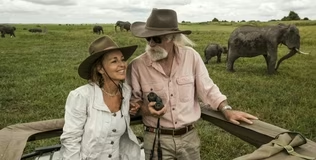
JOHN YANG: For more than 40 years, Beverly and Derek Joubert have lived with, photographed and filmed African wildlife.
The images they captured are beautiful, savage, haunting and mesmerizing.
They bear witness not just to the majesty of life on the African continent, but also to the host of threats, many of them man made, that confront both the animals and the wilderness.
They have a new book entitled "Wild Eye: A Life in Photographs."
It winnows down four decades of work to about 250 of the most powerful photos.
Earlier, I spoke with the Jouberts, photographer and conservationist Beverly and filmmaker Dereck.
I asked them why they published a retrospective now.
BEVERYLY JOUBERT, Award-winning Photographer and Filmmaker: It's really important to be able to look back and see what life was for us then and for, you know, all the animals and where we are today.
And, of course, we are losing at an alarming rate everything from the cats to elephants and landscape.
So we thought if we could bring a piece together that truly is celebrating these animals and hope that everybody will want to try and protect them.
DERECK JOUBERT, Award-winning Photographer and Filmmaker: I think that's true.
You know, I think that it's a time now for us to all reflect on what was and then determine what's going to be.
JOHN YANG: What are the threats that you see?
DERECK JOUBERT: Well, we've seen quite a lot of poaching threat.
We've seen over hunting in a lot of places.
It seems like Africa more and more is becoming this forgotten place that people are so involved in their lives in the rest of the world that the future of wildlife is off the agenda.
JOHN YANG: How did you decide?
How did you pick which images went into the book?
BEVERLY JOUBERT: That was a challenge.
I can tell you, going through 40 years of photography, the image really needed to tell a story.
Some of the images are a little harder to look at, but they are telling a powerful story.
And so that's how, you know, we selected.
Not every image will go on a wall, but they're important to be able to tell the story of Africa's wildlife.
DERECK JOUBERT: I also think that some of the storytelling that was chosen through these images spoke more about moments before the image was taken and what's going to happen after the image was taken.
So these are not just snapshots in town.
These are indicators or reflections of a story that's going on there, and so draw the audience of the viewer in.
JOHN YANG: Let's talk a little bit about that by looking at some of the pictures.
First, there's a leopard in a baobab tree.
And in the book, in the caption, you've given this leopard a name.
Do you often do that with the animals you photograph?
BEVERLY JOUBERT: When we're out there, you know, we'll spend two to three years with the animals that we're filming.
So, yes, we do if we get to know animal.
This particular leopard we got to know very well because it was the mother to a little leopard that we stayed with for four years.
And the little leopard we stayed with for four years is the front cover of the book "Wild Eye."
DERECK JOUBERT: And I think there are a couple of more functions of actually naming these things.
We give them characters, or rather we reveal their characters.
If it's just, you know, leopard number F125, there's no characterization there.
But these are real personalities, and I think that we do them a disservice by not at least giving them a fair shot at winning your heart.
BEVERLY JOUBERT: One of the important about her up in that baobab tree is more than 2,000 years old.
So it's not only about protecting her as one of the cat species, but it's by protecting the land so you can protect everything else, all the biodiversity and the fauna and flora.
JOHN YANG: The next photo is of a lion cub, and it really is sort of almost a star photo.
You've got that rainbow perfectly placed behind this cub.
Talk about that, about how you get the right image, you want frame it.
And also just that getting it from.
BEVERLY JOUBERT: The right perspective, it's always a challenge to get the right image.
I mean, I take thousands of images that would never be perfect in my eyes or in Derek's eyes, but this particular one line was observing the rest of the pride.
And so it meant that we could move around, and as we moved around with our vehicle, we could position the rainbow exactly behind this little one.
DERECK JOUBERT: Of course, there's some tension within this image because while the rainbow is perfectly positioned for Beverly's lens position, perfectly for mine.
And so there's dialogue in the vehicle is, can you go forward about two feet?
I'm going, no, why would I do that?
JOHN YANG: You're the filmmaker there.
DERECK JOUBERT: Exactly.
And so we've always got to weigh that up and balance that and our lives.
BEVERLY JOUBERT: Yeah.
JOHN YANG: Then the next photo is of lions in trees.
And you say it's unusual to find lions in trees.
BEVERLY JOUBERT: It is.
Some areas the lions have started adapting and going up trees.
But the problem is not like a leopard.
They can't go straight up a tree trunk.
They can't lock their ankles like a leopard can.
So it's a challenge for them.
So this was a beautiful reclining tree, so it was easy for them to get up.
JOHN YANG: I've heard both of you say that you're big cat people.
Talk about that.
DERECK JOUBERT: Well, Beverly has a wild side to her.
No, we -- when we came out of university, our very first assignment out there, even though were researchers then, was studying lions and so that got into our DNA and we studied lions for 35 years.
Somewhere along the line we found cameras and we started photographing and filming them as well.
And we just keep coming back because that's where we feel most imbalance, I guess.
BEVERLY JOUBERT: Yeah.
And you know, over a 60 year period, they've declined by 95 percent And that's all the big cats.
And so leopards have this beautiful skin and we need to speak out for them because everybody know would like to acquire one of their skins.
And with so few left in Africa, we feel like we need to be the ambassadors.
JOHN YANG: And of course, you don't just photograph big cats, you also photograph other animals.
We've got these zebras in the book.
You say these zebras are actually going someplace.
BEVERLY JOUBERT: These zebras, I mean, it's quite an unusual situation.
So when the rains come, they go to one of the harshest places, which is a salt pan called the Makgadikgadi Pans.
And they're going there because they need minerals.
So as the rains come and all the pans fill up, they go there, they spend a couple of months there, they build their bodies with all the minerals and then they come back.
So they are migrating in that image.
DERECK JOUBERT: And I think an image like this is exactly what I was talking about earlier on, John.
It talks about who.
So these zebras are in or what and in what landscape?
So the stalks of the reeds in the perfect habitat for them because it matches and speaks to architecturally what a zebra is.
And then what next?
Why would they be wading through the water to go to water?
And I think the best photographs end with a question mark.
JOHN YANG: Not just the beauty, but also some of the violence of life in Africa.
A photograph of a lion battle with an elephant and then you also capture the kill.
And you said that this kill took days because the elephant is so large.
I mean, I find this image difficult to look at.
But what was it to watch that, to be there while that was going on?
BEVERLY JOUBERT: So the first image, that is a female cow.
And that happened at 2 in the morning.
So that is a challenge, you know, on its own.
I remember shouting out to Dereck, he had to wake up and start filming.
And I start, you know, taking the photographs.
And she was about 21 years old.
Nine lions in the pride.
And it was opportunistic.
They were the first to ever capture lions trying to bring down an elephant.
And this particular image was a story of hope for us because she fought for her life for at least a half an hour and she did get away.
DERECK JOUBERT: So these two images together play light and dark.
They play hope and desperation and despair.
And so the female that Beverly's talking about did actually get up and run off.
She had a will to live.
And this older bull in this image gave up hope.
And that was a long, grueling couple of days for us to sit and film and photograph through.
But the way that we get through that is we fortify ourselves with the knowledge that we didn't play a role in this.
We're silent observers within this.
And this is going on up and down through Africa behind us one way or the other.
We can't intervene.
We can't change that destiny for these animals.
But what we can do is use our tools, our cameras, to bring that to audiences so there's a better understanding of the facets and nuances of nature.
Otherwise we go down self-generating sense that everything out there is Disneyland.
And I think it's good for people to know that there's a harsh side to Africa as well.
JOHN YANG: You've been at this 40 years, hundreds of photographs in this book.
Is there an image you're still chasing, an image you want to capture that you haven't yet?
BEVERLY JOUBERT: There's always an image I'm still chasing.
I don't quite know what it is because I need to be open to, you know, whatever comes our way.
But the images definitely need to be preserving and protecting wildlife in Africa.
DERECK JOUBERT: And I think that's the journey, isn't it?
Is not necessarily caring about where you're going to end up, but being open to the steps along the journey as they present themselves to you.
BEVERLY JOUBERT: Yeah.
JOHN YANG: Dereck and Beverly Joubert, thank you very much.
Just amazing pictures.
Thank you very, very much.
BEVERLY JOUBERT: Thank you, John.
DERECK JOUBERT: Thank you.
BEVERLY JOUBERT: Really appreciate.
JOHN YANG: And that is PBS News Weekend for this Saturday.
I'm John Yang.
For all of my colleagues, thanks for joining us.
See you tomorrow.
Displaced Gazans face dire conditions months after ceasefire
Video has Closed Captions
Clip: 12/13/2025 | 6m 5s | Displaced Palestinians struggle with cold, malnutrition in Gaza months after ceasefire (6m 5s)

How tariffs are making the holidays less merry for shoppers
Video has Closed Captions
Clip: 12/13/2025 | 3m 55s | How tariffs on China are making the holiday season less merry for shoppers (3m 55s)
Jouberts reflect on 40 years of African wildlife photography
Video has Closed Captions
Clip: 12/13/2025 | 10m 49s | Beverly and Dereck Joubert reflect on 40 years of African wildlife photography in new book (10m 49s)

News Wrap: Trump vows retaliation for U.S. deaths in Syria
Video has Closed Captions
Clip: 12/13/2025 | 3m 1s | News Wrap: Trump vows retaliation for killing of Americans in Syria (3m 1s)
Providing Support for PBS.org
Learn Moreabout PBS online sponsorship
- News and Public Affairs

FRONTLINE is investigative journalism that questions, explains and changes our world.

- News and Public Affairs

Amanpour and Company features conversations with leaders and decision makers.












Support for PBS provided by:
Major corporate funding for the PBS News Hour is provided by BDO, BNSF, Consumer Cellular, American Cruise Lines, and Raymond James. Funding for the PBS NewsHour Weekend is provided by...