
March 11, 2026 - PBS News Hour full episode
3/11/2026 | 57m 46sVideo has Closed Captions
March 11, 2026 - PBS News Hour full episode
Wednesday on the News Hour, Iran targets ships in the Strait of Hormuz, further roiling the global economy. We explore whether tapping into oil reserves can ease some of the pressure. Soldiers from Ukraine share what they have learned while defending against waves of Iranian-made drones launched by Russia. Plus, the Trump administration's immigration crackdown spreads fear among legal immigrants.
Problems playing video? | Closed Captioning Feedback
Problems playing video? | Closed Captioning Feedback
Major corporate funding for the PBS News Hour is provided by BDO, BNSF, Consumer Cellular, American Cruise Lines, and Raymond James. Funding for the PBS NewsHour Weekend is provided by...
Support provided by:

March 11, 2026 - PBS News Hour full episode
3/11/2026 | 57m 46sVideo has Closed Captions
Wednesday on the News Hour, Iran targets ships in the Strait of Hormuz, further roiling the global economy. We explore whether tapping into oil reserves can ease some of the pressure. Soldiers from Ukraine share what they have learned while defending against waves of Iranian-made drones launched by Russia. Plus, the Trump administration's immigration crackdown spreads fear among legal immigrants.
Problems playing video? | Closed Captioning Feedback
How to Watch PBS News Hour
PBS News Hour is available to stream on pbs.org and the free PBS App, available on iPhone, Apple TV, Android TV, Android smartphones, Amazon Fire TV, Amazon Fire Tablet, Roku, Samsung Smart TV, and Vizio.
Providing Support for PBS.org
Learn Moreabout PBS online sponsorshipGEOFF BENNETT: Good evening.
I'm Geoff Bennett.
Amna Nawaz is away.
On the "NewsHour" tonight: Iran targets ships in the Strait of Hormuz, further roiling the global economy.
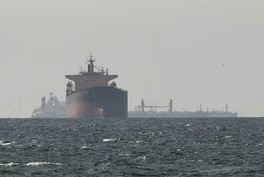
Can tapping into oil reserves ease some of the pressure?
Drone warfare.
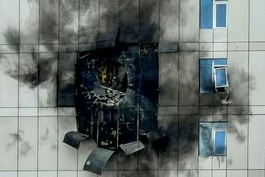
Soldiers from Ukraine's front line share their expertise with the U.S., lessons learned from defending against waves of Iranian-made drones launched by Russia.
And the Trump administration's immigration crackdown spreads fear among legal immigrants.
PASCHAL NWOKOCHA, Immigration Attorney: It's not just going after those who have criminal record.
It's just harassing anybody who looks like me or who doesn't fit the mold they have in mind.
(BREAK) GEOFF BENNETT: Welcome to the "News Hour."
The Persian Gulf energy crunch deepened today, as the U.S.
and Israel launched new strikes on Iranian targets.
Iran struck back across the region and effectively shut down the vital Strait of Hormuz, prompting countries around the world to take unprecedented steps to keep oil flowing.
We begin tonight with special correspondent Leila Molana-Allen from Qatar.
LEILA MOLANA-ALLEN: The roiling waters of the Persian Gulf further inflamed after Iranian missiles this morning struck three cargo ships, this one manned by the Thai navy, engulfed by fire, near one of the world's most critical oil passageways, the Strait of Hormuz, which snakes between Iran and the Arabian Peninsula.
Maritime groups say, in all, Iran has struck at least a dozen vessels there, effectively bringing traffic to a halt and global energy fears to an all-time high.
Today, Iran pledged it won't hold back.
LT.
COL.
EBRAHIM ZOLFAGHARI, Iranian Military Spokesperson (through translator): We will never allow even a single liter of oil to pass through the Strait of Hormuz for the benefit of the United States, the Zionists or their partners.
Any vessel whose ship or oil cargo belongs to them will be considered a legitimate target.
LEILA MOLANA-ALLEN: The situation has caused energy prices around the world to skyrocket, to offset the surge, an unprecedented response from the International Energy Agency, which announced it would release 400 million barrels of oil from its emergency stocks.
That's roughly 20 days' worth of the strait's exports, making it the largest distribution of reserves in history.
IEA Director Fatih Birol: FATIH BIROL, Executive Director, International Energy Agency: This is a major action aiming to alleviate the immediate impacts of the disruption in markets.
But, to be clear, the most important thing for a return to stable flows of oil and gas is the resumption of transit through the Strait of Hormuz.
LEILA MOLANA-ALLEN: It all comes amid fears that Iran is preparing to mine the Strait of Hormuz in an effort to shut down shipping altogether.
Leaving the White House today, the president said U.S.
oil companies should proceed with using the strait and reiterated to reporters what he told Axios, that there's -- quote -- "practically nothing left to target in Iran."
DONALD TRUMP, President of the United States: They have lost their navy.
They have lost their air force.
They have no anti-aircraft apparatus at all.
They have no radar.
Their leaders are gone.
And we could do a lot worse.
LEILA MOLANA-ALLEN: Still, joint U.S.-Israeli attacks continue across Iran, this explosion sending shockwaves through the northwestern city of Tabriz.
And, in the capital, bombs gutted neighborhood shops like this one.
A new Israeli intelligence assessment revealed that Iran's newly installed supreme leader, Mojtaba Khamenei, was lightly wounded at the start of the war.
Israel's defense minister today vowed to carry on for as long as it takes.
ISRAEL KATZ, Israeli Defense Minister (through translator): We will continue to act and crush this regime and its strategic objectives in Tehran and throughout Iran day after day.
LEILA MOLANA-ALLEN: Israel's campaign against Iran includes strikes on Hezbollah, the Iran-backed proxy group in Lebanon.
There, attacks ramped up beyond Hezbollah strongholds in Beirut's southern suburbs today, and continued to hammer Southern Lebanon.
So far, well over 500 have been killed and some 700,000 displaced.
MARIAM HASSAN RIDA, Displaced Lebanese (through translator): I want to go back to my hometown.
I'm afraid.
I'm scared for myself.
There are strikes here and there are strikes there.
I'm confused about where to go.
(SIRENS BLARING) LEILA MOLANA-ALLEN: And Iran's counterattacks have escalated to what its Islamic Revolutionary Guard Corps called today the most intense yet.
Missile remnants lay scattered in Central Israel after Iran said it's increasing its use of custom munitions against them.
Eyewitness video captured the moment an oil depot in Oman blew up after it was struck by an Iranian drone.
Oman had been the chief mediator between the U.S.
and Iran before the U.S.
and Israel launched the war.
And two drones fell near Dubai International airport, one of the world's busiest, continuing Iran's strategy of destabilizing its Gulf neighbors and energy markets.
Here in Qatar, Iranian attacks ramped up too, with multiple incoming missile and drone launches intercepted throughout the day.
A Foreign Ministry spokesperson for the country, which was previously a key neutral negotiator between Iran, the United States and Israel, said Qatar reserved the right to defend itself if necessary and had no plans to reconsider its strategic alliance with the United States over Iranian attacks on U.S.
bases in the region, but affirmed its belief that the only way this conflict will come to an end is via diplomatic means and urged all parties to come to the negotiating table to avoid any further escalation.
For the "PBS News Hour," I'm Leila Molana-Allen in Doha, Qatar.
GEOFF BENNETT: The decision by the International Energy Agency, or IEA, to tap into oil reserves is historic in its size and scope; 400 million barrels dwarfs the number of barrels that were released after Russia invaded Ukraine.
But there are many questions about whether this more ambitious effort will stop a surge in oil and gas prices if the war endures.
To explore some of these questions, we're joined now by Clay Seigle, a senior fellow in the Energy, Security and Climate Change Program at the Center for Strategic and International Studies.
Thank you for being with us.
So the IEA has not laid out a clear timeline for when this release could begin, but in your view, how quickly could it hit the market and how much relief could it provide?
CLAYTON SEIGLE, Center for Strategic and International Studies: Good evening.
The oil that is expected from the IEA's strategic drawdowns could hit the market relatively quickly.
It's a little bit of a function of whether industry, meaning the oil companies that are connected to those reserves, are ready to receive those barrels or if they have other commercial operations that are taking up bandwidth.
But, for the most part, as soon as the decision is made, within days, that oil can begin flowing to industry.
GEOFF BENNETT: And President Trump has said that the U.S.
will tap the Strategic Oil Reserve.
Of course, as you well know, those strategic reserves are typically used for short-term disruptions, not prolonged crises.
How much can this effectively stabilize prices?
CLAYTON SEIGLE: It all depends on the duration of the disruption.
So the 20 million barrels per day of oil that come from the Mideast Gulf and supplied world markets is really must-have for global economic prosperity and the kind of prices, inflation, economic conditions that we're used to.
So what a measure like drawing down reserves from the International Agency and the Strategic Petroleum Reserve can do is buy us more time.
They can extend a lifeline for us to complete the operation in the Gulf and reach a postwar settlement with the Iranians that will bring security back to the region and allow those exports to flow again.
So it can buy us more time, but it's not a substitute to getting those exports going again.
It's really just a temporary measure.
GEOFF BENNETT: A lifeline, yet not a substitute.
How much oil, how much of America's reserves could be tapped here?
CLAYTON SEIGLE: Well, the reserve is only about 60 percent full, following that big drawdown that you mentioned from 2022.
And the thing about the Strategic Petroleum Reserve is it's designed to draw down very quickly, which is what was done a few years ago.
But because of the plumbing and other considerations, it can only be refilled very gradually.
And that's why we're only at about the 60 percent level.
So I think that U.S.
policymakers will probably be very judicious in deciding the volumes that they want to commit to this, but also, again, with an eye toward how soon the cause of the problem, which is the blockage in the Middle East Gulf and the Strait of Hormuz, can be resolved.
Think of the lifeline like this.
If you lose your job, and maybe we all have, hopefully, you have an emergency fund or rainy day fund in the bank that you can use to pay the bills until you get a new paycheck.
It's not instead of getting a new job and a paycheck.
It's in addition to for the short term.
So you still need to get that job and the paycheck going again.
And the world still needs to get that oil from the Mideast Gulf flowing to market.
GEOFF BENNETT: Yes.
The IEA has only done this five times before, including twice after Russia's invasion of Ukraine.
How much difference did those releases actually make for supply and prices?
CLAYTON SEIGLE: That was a really interesting case study from 2022 because the market was facing the prospect of five million barrels per day of Russian oil potentially being removed from the market.
And, famously, crude prices soared to $130 per barrel, United States pump prices, what we pay at the gasoline station, $5 a gallon.
And that's the nationwide average.
It was a lot higher in certain states.
But that was all just fearing five million barrels a day disappearing.
At the end of the day, those Russian barrels didn't disappear from the market.
They were just reshuffled to other buyers around the world.
And so once that happened, the oil that had been released from the drawdowns stayed on the market and kept prices lower for longer.
GEOFF BENNETT: Beyond tapping the reserve, what other tools do governments actually have to stabilize energy markets in a crisis like this?
CLAYTON SEIGLE: You know, the supply-side interventions are pretty limited in their potential to help.
And so the Trump administration is reportedly considering a lot of different tools in the toolkit, everything from the Treasury potentially intervening in the oil futures market to put a short position to backstopping insurance for the oil and gas cargoes that have been stranded, pending safer conditions to transit through the Gulf and the strait.
And then there's also consideration of other measures, like waiving certain environmental specifications on the handling and processing of refined products like gasoline, jet fuel, diesel.
But I just have to stress that all of these measures can really only buy us a little bit more time and partially offset the missing barrels from the Mideast Gulf.
There's also some measures that folks in the region are taking.
And so Saudi Arabia in particular has the ability to redirect some of its Gulf exports, not all of them, but some of their exports from the Strait of Hormuz and bypass that area and send it out through the west coast of Saudi Arabia into the Red Sea.
But those volumes are also limited.
And then you potentially have to deal with other threats to shipping, notably from the Houthi militia that has plagued commercial shipping for years in that part of the world.
We could see that again.
GEOFF BENNETT: Clay Seigle, thanks so much for your insights.
CLAYTON SEIGLE: Thank you.
GEOFF BENNETT: In the day's other headlines: A series of tornadoes killed at least two people in Northwestern Indiana and leveled homes and businesses in neighboring Illinois.
An elderly couple was killed when a tornado struck their home in Lake Village, Indiana.
Fire officials there say at least 10 others were injured.
And in Kankakee, Illinois, a tornado flattened entire neighborhoods.
Residents were left in shock, while the city's mayor expressed relief that lives were spared.
WOMAN: It was just devastation.
It reminded me of the movie "Twister."
CHRISTOPHER CURTIS, Mayor of Kankakee, Illinois: We're very fortunate that where the tornado did come through at the city of Kankakee was mostly our commercial industrial area, and not heavy residential area, but it has suffered significant damage.
GEOFF BENNETT: That same weather system swamped roads in places in and around Grand Rapids, Michigan, and reportedly dropped hail the size of golf balls.
And there's more bad weather ahead.
Widespread storms with damaging winds will stretch from Houston, Texas, all the way through the mid-Atlantic and up to Philadelphia.
The Department of Homeland Security reactivated its global entry program early this morning.
The fast-track service for preapproved travelers entering the U.S.
was paused last month because of the partial government shutdown.
A DHS spokesperson said the decision was intended to help alleviate the disruptions to travelers caused by the shutdown.
A handful of U.S.
airports have seen long security lines and delays lasting for hours in recent days amid a shortage of airport screeners.
U.K.
Prime Minister Keir Starmer was warned of the reputational risk in appointing Peter Mandelson as U.S.
ambassador due to his ties to Jeffrey Epstein.
That's according to documents released today by the British government.
The 147-page report lays out Mandelson's ties to Epstein, as well as unrelated financial issues.
Mandelson was arrested last month on suspicion of misconduct in public office.
He denies any wrongdoing and has not been charged.
Cabinet minister Darren Jones said the government fell short in its due diligence of Mandelson and that Epstein's victims are their first priority.
DARREN JONES, Chief Secretary to U.K.
Prime Minister: Peter Mandelson's behavior was an insult to them and their suffering.
I am therefore sorry that these events leave those victims with no choice but to relive their horrors with still too little justice being served.
GEOFF BENNETT: Meantime, in Washington, Epstein's longtime accountant Richard Kahn told lawmakers today that he was, in his words, not aware of the nature or extent of Epstein's abuse until after his death.
That's according to opening remarks obtained by reporters ahead of a closed-door deposition by the House Oversight Committee.
Kahn remains an executor of Epstein's estate and also denies any wrongdoing.
Seven members of Iran's national women's soccer team remain in Australia, an Australian government official said today.
That's as the rest of their teammates head back to a country now at the center of a widening war.
The players had traveled to Australia for the Asian Women's Cup just before the war started.
Six of the women have accepted humanitarian visas that will allow them to remain in Australia for good.
A seventh who had initially sought asylum has since decided to return to Iran, a decision supported by Australia's home affairs minister.
TONY BURKE, Australia Home Affairs Minister: In Australia, people are able to change their mind.
People are able to travel.
And so we respect the context in which she has made that decision.
For every member of this delegation, they have been shown a respect by Australia that would be unfamiliar to them in Iran.
GEOFF BENNETT: Also today, Iran's sports minister told state television that -- quote -- "under no circumstances" would the men's team participate in this summer's soccer World Cup, which is being hosted by the U.S., Mexico and Canada.
Those comments came hours after FIFA's president Gianni Infantino said that President Trump told him Iran would be welcome.
On Wall Street today, stocks ended mixed as oil prices turned higher and investors digested the latest report on inflation.
The Dow Jones industrial average fell nearly 300 points on the day.
The Nasdaq managed a slight gain of almost 20 points.
The S&P 500 closed just barely in the red.
Still to come on the "News Hour": the U.S.
and Ukraine worked to combat Iran's drone attacks; President Trump demands a congressional bill to combat very rare occurrences of voter fraud; and the immigration crackdown in Minnesota sparks fear even among people in the country legally.
For more than 10 days, Iran has unleashed one weapon in particular at countries that host U.S.
troops.
Shahed drones have targeted American bases, killing U.S.
troops and hitting civilian infrastructure and energy facilities.
But long before they flew across the Middle East, Shaheds fired by Russia targeted Ukrainian troops and infrastructure.
We have two looks at the drone threat, starting with special correspondent Jack Hewson, one of the few foreign correspondents who reported from Kharkiv at the beginning of the full-scale invasion.
Jack returns to that Eastern Ukrainian city to meet frontline troops, who have more experience facing Shahed drones than anyone else.
JACK HEWSON: Kharkiv's air war doesn't begin in the city.
It starts out here in the fields and villages that lie between the front line and the regional capital.
We're on our way to a position about 20 kilometers from the Russian line in Izyum in Kharkiv province.
And, strangely, even though we're a long way from Kharkiv, the city itself, this is where air defense actually begins.
Shahed fly over this area in the direction of the city, and it's here that they're intercepted.
And it's also where they intercept Russian observation drones as well.
Notice the nets.
That's to protect cars like ours.
Making this journey more harrowing is the fact that short-range first-person view, or FPV, drones have hit vehicles here.
They have an expanded range and are now guided by fiber-optic cable to evade electronic jamming.
"ASKET," Ukrainian 115th Mechanized Brigade: Everything which is closer than 40 kilometers could be destroyed by Russian drones, by different types of drones, not only FPV drones but Lancet and a lot of other types of Russian drones.
JACK HEWSON: Drone and missile strikes, many launched from deep inside Russia have hit Kharkiv, Ukraine's most bombarded city, for years.
And it's only getting worse.
In addition to attack drones, Russian forces fly reconnaissance drones and longer-range Iranian-made Shaheds across this area and into Kharkiv city itself.
To counter, Ukraine has developed reconnaissance and interceptor drones of its own and pushed its air defense network out towards the front line, trying to intercept before they reach the city.
They operate from below ground, hiding from Russian recon drones like the ZALA and Orlan.
The latter is a direct threat to Kharkiv city, helping to guide missiles and Shahed drones onto their targets.
They also threaten frontline troops.
We blurred some images at the unit's request to protect the unit's operational security.
"SMILE," Drone Pilot, Ukrainian 115th Mechanized Brigade (through translator): The Orlan knocks out our units.
They knock out our people, our equipment.
They also actively knock out our artillery.
Due to its relatively powerful zoom, it has both optical and digital zoom.
It sees very far and it has the ability to help target both guided munitions and artillery.
It can target just everything.
JACK HEWSON: But one of the most difficult targets for these pilots is the Shahed.
KUCHERIAVYI, Drone Pilot, Ukrainian 115th Mechanized Brigade (through translator): Because it flies low and is very difficult to detect, plus the fall weather conditions, and it simply flies fast.
JACK HEWSON: Despite the challenges, Ukrainian crews are scoring hits like this one, but for every hit, many more slip through.
There is a constant race to keep up with each innovation and counterinnovation in tactics and technology between the Hunter and the hunted.
According to Commander Mer, the evolution continues and, as their crews adapt, so do the Russians.
"MER," Unit Commander, Ukrainian 115th Mechanized Brigade (through translator): Now the Shaheds are even being equipped with radio-electronic interference systems to interfere with our interceptor.
The enemy also plays with the altitude and at the same time he began to launch a much larger number of Shaheds in one group.
That is, before the group consisted of three or four enemy Shaheds.
Now this group, their number has increased to eight or nine.
JACK HEWSON: According to the commander, innovation happens primarily on the battlefield supported by start-ups and NGOs.
"MER" (through translator): The state can only provide what has already proven itself and has results.
What has proven itself and has results is no longer effective on the battlefield.
Such dynamics mean that we have to try.
We have to constantly put the latest technologies in place and gamble with what works.
JACK HEWSON: To understand what they're up against, the unit takes us to examine one of the drones they have recently brought down.
This one had a gasoline-powered propeller motor, allowing it to travel at up to 115 miles an hour, but newer models are presenting bigger challenges.
"AKUSHER," Ukrainian 115th Mechanized Brigade (through translator): Their warhead has from 40 to 50 kilograms of explosives, and they have already modified the design of the Shahed itself in the structure and are doubling the warhead.
I would also like to add that they are pioneering using jet engines.
True, they haven't been detected in our zone yet, but these are also their changes, their tactics.
JACK HEWSON: And with jet-powered Shahed coming to this war, with top speeds of more than 310 miles per hour, Ukraine's air defense teams will continue to have their work cut out.
For the "PBS News Hour," I'm Jack Hewson in Kharkiv, Ukraine.
GEOFF BENNETT: Now that the Shahed drone threat has arrived in the Middle East, the U.S.
and Arab allies formally requested Ukraine's help.
And, this week, Ukrainian troops have arrived to start training.
Nick Schifrin speaks to a Ukrainian official key to that effort.
NICK SCHIFRIN: And I'm now joined by the adviser on strategic affairs to Ukraine's President Volodymyr Zelenskyy Oleksandr Kamyshin.
Oleksandr, thanks very much.
Welcome.
Good to see you again.
OLEKSANDR KAMYSHIN, Strategic Affairs Adviser Ukrainian President: Happy to see you again.
NICK SCHIFRIN: What is Ukraine now providing to the Middle East now that it is the Middle East that is facing the threat of Shahed drones, as Ukraine has faced for years?
OLEKSANDR KAMYSHIN: Well, this night, we had probably the biggest in our history, the record high night of the number of Shaheds and missiles coming in, and that was 700-plus.
So we're going through really complicated days, even though we got 11 official requests from Middle East countries.
NICK SCHIFRIN: Eleven requests across the region.
OLEKSANDR KAMYSHIN: European and U.S.
as well, to help with deterring Shaheds in the Middle East.
We get over 60,000 of Shaheds for the last year.
We learned now to take more than 90 percent of them down at cheap cost, in efficient way, and that's probably something we would be happy to share with our partners.
NICK SCHIFRIN: There's no one way to shoot these drones down, so the Ukrainians that are arriving in the Middle East, will they bring with them the ability to shoot down the drones, to bring down the drones electronically?
What are the capabilities that they're going to help teach these countries?
OLEKSANDR KAMYSHIN: That's all types of counterdrone solutions.
That's E.W.
NICK SCHIFRIN: Electronic warfare.
OLEKSANDR KAMYSHIN: Yes.
That's sonic acoustic sensors, and that's drone interceptors.
All types of them finally give us the capability to take down over 90 percent of Shaheds.
NICK SCHIFRIN: How difficult has it been for Ukraine to learn over the years how to create your own technology to do this on a cheap basis regularly?
OLEKSANDR KAMYSHIN: Well, Nick, last time we met, three years ago, we would not produce so much.
Now we have learned how to produce Zbroya.
That's Ukrainian name for weapon.
The drone interceptor cost is less than $5,000.
The cheapest ones are roughly $2,000.
Considering the cost of Shahed, because some of them cost from $50,000 to $150,000, that's pretty much efficient.
And, at this point, the fast relief is sending some assets and some trainers to them, and later we would be happy to go on with investments, joint procurement, joint production, whatever.
NICK SCHIFRIN: Is that Ukraine's long-term goal to get some of this international investment to build up its own capabilities?
OLEKSANDR KAMYSHIN: Exactly.
There is a drone deal in discussion between U.S.
administration and my President Zelenskyy, and we would be happy if the drone deals finally happens and we will have joint production of Ukrainian Zbroya in U.S.
NICK SCHIFRIN: As part of that drone deal, a senior Ukrainian official tells "PBS News Hour" that, last August, President Volodymyr Zelenskyy offered Ukrainian anti-drone technology to help defend the Middle East.
The official says the offer received no formal reply until Iranian drones started landing in the Gulf 11 days ago.
What has been the United States, what has been the Trump administration's role in trying to get some of this Ukrainian technology into the Middle East?
OLEKSANDR KAMYSHIN: At some point, there was a discussion that my president doesn't have cards.
DONALD TRUMP, President of the United States: You don't have the cards.
You're buried there.
Your people are dying.
OLEKSANDR KAMYSHIN: Looks like the card is already in his hands, and looks like the card is called Zbroya.
That's Ukrainian weapon.
We are happy to share the lessons learned.
NICK SCHIFRIN: Has Russia been improving Shahed drone technology that originally, of course, came from Iran, in order for these Shaheds to be better at evading air defense?
Have you seen that in Ukraine?
And do you know whether that technology has been transferred to Iran?
OLEKSANDR KAMYSHIN: Indeed, Nick, they made it better in Russia.
They innovate well.
We have to accept it.
And at this point, we know that they share back to Iran not only the technology, but also some components.
Some drones taken down in the Gulf have Russian components produced in Russia.
So, finally, it's both-way exchange of the technology between Iran and Russia.
NICK SCHIFRIN: And, finally, is Ukraine worried that, with the world's attention on Iran and the Middle East, the United States' attention on air defense for its own bases in the Middle East, that Ukraine will get fewer weapons?
OLEKSANDR KAMYSHIN: We are helping to make secure Gulf.
And we believe that we will still keep the same support from U.S., from Europe, from all our strategic partners, and we will get more with helping the Gulf.
The axis of evil is working well.
They support each other in a very strong way.
I strongly believe that all the allies, all the free world, as I say, will stand together.
And with things we learn how to produce in Ukraine, with resources you have, we will make the free world safer.
NICK SCHIFRIN: Adviser on Strategic Affairs to President Zelenskyy Oleksandr Kamyshin, thank you very much.
OLEKSANDR KAMYSHIN: Thank you, Nick.
GEOFF BENNETT: President Trump vowed this week not to sign any bills into law until a sweeping new voting bill is passed.
Our White House correspondent, Liz Landers, takes a closer look at its prospects.
LIZ LANDERS: Early Sunday morning, hours after returning from Delaware, where he took part in the solemn observance of the return of remains of six U.S.
soldiers killed, President Trump posted about the SAVE America Act.
Quote: "It supersedes everything else," he wrote, and -- quote -- "must go to the front of the line.
I as president will not sign other bills until this is passed."
DONALD TRUMP, President of the United States: And, perhaps most importantly, I'm asking you to approve the SAVE America Act.
(CHEERING) LIZ LANDERS: If passed, the Safeguard American Voter Eligibility, or SAVE America, Act would transform voting in this country in two major ways.
It would require all Americans to prove U.S.
citizenship when registering to vote, and it would require all voters to show an I.D.
when voting in person or by mail.
Voters submitting absentee mail ballots would have to provide a photocopy of their I.D.
The bill would also require states to frequently review voter rolls and remove any noncitizens.
And it would mandate states share voter registration data with the federal government, which most states have refused to do, a move backed by several federal judges.
DONALD TRUMP: We don't want people that aren't citizens of our country voting.
We don't want people that aren't studied, and we don't want people that can't love our country voting in our elections.
So it's very simple.
LIZ LANDERS: But it's not that simple.
By any definition, the number of ballots cast illegally and by noncitizens in America elections is incredibly small.
DAVID BECKER, Executive Director, Center for Election Innovation and Research: We know our elections are more secure than ever.
We know we have more protections and checks and balances against fraud than ever.
And we also know that this administration has gone out hunting for fraud with all of the tools of the federal government over the last year, and they have found virtually none.
LIZ LANDERS: A study by the Trump administration's Department of Homeland Security found that, of the 49.5 million voter registrations that were checked for the 2024 election, about 10,000 cases were referred for additional investigation of noncitizenship.
That's roughly 0.02 percent of names processed.
In Georgia, a 2024 audit of its 8.2 million registered voters found only 20 noncitizens who had registered.
RICK HASEN, UCLA School of Law: If you're a noncitizen and you sign under penalty of perjury that you are a citizen and you're eligible to vote, you're committing a felony which could render you not only deportable, but also get you jail time.
And for what?
For -- to have one vote.
So it's really not the way that elections are stolen.
LIZ LANDERS: And Americans are not overly concerned about the chances of voter fraud.
In our new PBS News/NPR/Marist poll out today, 66 percent of Americans are confident their state or local government will run fair elections in November, which is down from 76 percent in October 2024; 33 percent of adults believe the biggest threat to safe and secure elections is voter fraud.
Republicans are much more concerned about this than Democrats.
KAROLINE LEAVITT, White House Press Secretary: You need an I.D.
to go and purchase alcohol.
You need an I.D.
to go to the library and check out a book.
And so the president thinks you should have an I.D.
to vote in our nation's elections.
LIZ LANDERS: But requiring I.D.
documents like passports and birth certificates could disenfranchise millions of people.
RICK HASEN: If you're poor, you're moving a lot, you're say a student who's gone away to college, you have changed your name because you have gotten married or for some other reasons, all of those people would have more difficulty obtaining these documents.
LIZ LANDERS: About half of Americans don't have passports and many do not have a copy of their birth certificate.
The Brennan Center for Justice estimates that more than 21 million Americans lack ready access to those documents.
And voting rights advocates say the SAVE America Act requirements could disproportionately affect older Americans and low-income voters, another concern, newly married voters.
A 2023 Pew survey found that more than 80 percent of women and 5 percent of men change or hyphenate their names after marriage, meaning their passport, birth certificate and other documents may not align, requiring additional paperwork to register to vote.
TAMMY PATRICK, National Association for Election Administrators: I don't think there's anyone that wants ineligible voters to participate in our democracy, full stop.
But what we do want to make sure is everyone who is eligible doesn't have obstacles that they have to overcome in order to participate.
LIZ LANDERS: When it comes to federal oversight of elections, President Trump's outside allies are also pressuring him to declare a national emergency around elections.
We asked the president about this recently.
Are you considering a national emergency around the midterm election?
DONALD TRUMP: Who told you that?
LIZ LANDERS: There's been reporting that there's an executive order, proposed executive order about this.
Are you looking at that?
Are you considering that?
DONALD TRUMP: No.
(CROSSTALK) LIZ LANDERS: The president has also said he regrets not using the National Guard in 2020 to seize election equipment.
Our poll asked Americans how they feel about the National Guard around voting sites.
A slim majority of Americans oppose National Guard's members around polling locations.
But 46 percent support this idea.
Democrats and independents overwhelmingly oppose the idea, but 73 percent of Republicans are in favor of having the National Guard monitor voting locations.
Are you surprised that 46 percent of Americans do support the idea of having National Guard's people outside of voting locations?
DAVID BECKER: I was surprised at that.
Look, it is illegal.
I,Is against federal law for troops or armed men -- that's the term in the statute -- to appear at any voting location.
That is 18-USC-592.
And hopefully the American people understand it.
It is part of our culture that we vote in a safe and secure environment.
MAN: Mr.
President.
MAN: Majority Leader.
LIZ LANDERS: The Senate is poised to take up the bill next week, where it is expected to fail.
For the "PBS News Hour," I'm Liz Landers.
GEOFF BENNETT: Minnesota is still dealing with the fallout from a massive monthslong federal immigration crackdown.
Even though the number of agents in the state has dwindled, many immigrants remain fearful.
As special correspondent Fred de Sam Lazaro reports, that includes those who entered the country legally.
FRED DE SAM LAZARO: The so-called Operation Metro Surge was billed as an effort to remove the -- quote -- "worst of the worst" from Minnesota.
TOM HOMAN, White House Border Czar: President Trump made a promise of mass deportation, and that's what this country's going to get.
FRED DE SAM LAZARO: But as the operation ramped up in January, the Trump administration announced it was taking new steps to tighten even legal immigration.
It launched Operation PARRIS, a reexamination of some 5,600 refugees who arrived legally in Minnesota, but hadn't yet received their permanent residency, also known as a green card.
Within days, there were reports of refugees being arrested by agents at their homes or when they arrived at a local ICE office after receiving notices to appear.
Refugees and advocates sued to block the enforcement.
SEO GIA VANG, Human Rights Activist: Refugee are among the most care carefully screened groups entering this country.
We are simply asking for promises to be kept.
FRED DE SAM LAZARO: In late January, a federal government judge temporarily stopped agents from arresting and detaining refugees in Minnesota.
"JAY," Refugee (through translator): I didn't think I would be targeted because I came to the U.S.
lawfully.
FRED DE SAM LAZARO: Jay was admitted to the United States as a refugee late in 2024.
We changed his name and aren't showing his face because he fears for his safety.
Before the judge's ruling in January, Jay received a letter asking him to appear for an interview about his status.
So he took time off from work and showed up at the Whipple Federal Building right behind me just outside of Minneapolis.
After hours of waiting, he was called forward, handcuffed, and led to a small room.
"JAY" (through translator): They didn't tell me why I was detained, just that my case would be processed quickly.
I figured they thought I was a criminal, and once they found out that I wasn't, they would let me go.
FRED DE SAM LAZARO: But Jay wasn't let go.
Instead, he was flown to a detention facility in Texas, he says, with no real explanation.
"JAY" (through translator): We slept on the floor.
We didn't change clothes.
We didn't take showers.
There wasn't enough food.
There wasn't enough water.
It was very hard to keep track of day and night.
The inside was horrible.
People were just shouting.
FRED DE SAM LAZARO: It was days before Jay spoke to a lawyer, whose main advice was not to sign any documents.
More than a week after arriving in Texas, Jay got word that a judge ordered his release.
"JAY" (through translator): Somebody brought a document for me to sign.
I asked them, what is this?
And I was told that it was a document indicating that I'm leaving the facility.
FRED DE SAM LAZARO: Did you sign it?
"JAY" (through translator): Yes, I did sign it because I wasn't handcuffed or shackled.
I felt happy and hopeful to be released.
I tried to read it, to understand it.
I was hoping it wouldn't hurt me.
I tried to find the word deportation on the document, and it didn't have that.
FRED DE SAM LAZARO: All told, Jay spent 14 days in custody before he was released in Minnesota and reunited with his wife and daughters.
"JAY" (through translator): From when I arrived in the U.S.
until I was detained, life was great.
After I was detained, all my hope became kind of dark.
The most difficult thing was about my kids and my wife.
My daughter didn't know where I was.
She said: "Why don't you come home?"
I said: "I'm coming.
I'm on my way."
I was just kind of tricking her the whole time.
PASCHAL NWOKOCHA, Immigration Attorney: For those who have done what is asked of them, they should not be punished.
FRED DE SAM LAZARO: Paschal Nwokocha is an immigration attorney in Minneapolis.
He says the crackdowns in Minnesota have left a mountain of litigation.
By one count, more than 1,000 wrongful detention lawsuits were filed in federal court since December.
That's three times the total filed between 2016 and 2024.
PASCHAL NWOKOCHA: It's not just going after those who have criminal record.
It's just harassing anybody who looks like me, who looks like you, or who doesn't fit the mode they have in mind.
FRED DE SAM LAZARO: Why do you suppose this is happening in the manner that it is?
PASCHAL NWOKOCHA: I don't know how else to say it that there is a concerted effort by the administration to define or to redefine the demographics of this country.
FRED DE SAM LAZARO: Now even those who already have permanent residency are finding a narrower path to U.S.
citizenship.
LAURA COOPER, International Institute of Minnesota: They certainly are making the questions harder and more obscure.
FRED DE SAM LAZARO: Laura Cooper is a retired law professor who teaches a class at the International Institute of Minnesota, helping immigrants prepare for the citizenship test.
She's been tracking both changes to the exam and the overall standards to become a citizen.
LAURA COOPER: Good moral character is one of the requirements, understandably, for attaining citizenship.
It used to be that if you had, for example, a vehicular violation, you paid your ticket and, when you applied for citizenship, you showed that you got a violation and you paid your ticket and that was it.
Now they have said that they will talk to people's neighbors.
So let's say someone has a neighbor that thinks that this immigrant doesn't cut his or her lawn properly or doesn't shovel the snow in time.
You wonder whether little things like that a neighbor could say, oh, these people are not good neighbors, they're not meeting the standards of our community.
WOMAN: These Minnesotans are our friends.
They're our neighbors.
They're our colleagues.
FRED DE SAM LAZARO: Late last month, the federal judge extended his order protecting Minnesota's refugees from being detained.
It came days after the Department of Homeland Security issued a memo making it official policy that agents can look for and arrest refugees who've been in the country for a year, but do not yet have green cards.
Advocates said the move was a dramatic break from past policy.
MEVLUDE AKAY ALP, International Refugee Assistance Project: Everybody should be disturbed by the administration's insistence that it has the right to indefinitely detain people who have legal status.
FRED DE SAM LAZARO: But in a statement to the "News Hour," a spokesperson for U.S.
Citizenship and Immigration Services said it was -- quote -- "not novel or discretionary.
It is a clear requirement in law.
The alternative would be to allow fugitive aliens to run rampant through our country with zero oversight.
We refuse to let that happen."
DHS did not respond to broader questions about its enforcement efforts or changes to the citizenship process.
For his part, Jay remains fearful.
If he's arrested again and forced to return to the country he fled, he worries he could be imprisoned or killed.
"JAY" (through translator): Nobody wants to leave their own country unless conditions are very difficult.
They want to improve their lives and leave past trauma behind.
So people need to understand that and have mercy on us.
I will obey the law.
I still want to apply for a green card and adjust my status.
If something worse comes and I don't have a choice, I will accept it.
I want my daughters to get a good education, so they don't live the life I lived.
FRED DE SAM LAZARO: For the "PBS News Hour," I'm Fred de Sam Lazaro in the Twin Cities.
GEOFF BENNETT: We will be back shortly.
But, first, take a moment to hear from your local PBS station.
It's a chance to offer your support, which helps to keep programs like the "News Hour" on the air.
For those of you staying with us, we take a second look now at the art of 3-D scanning, technology that's being used replicate classic works of art.
Paul Solman examines some ethical questions about what it means to preserve authenticity and democratize access in an age when the line between originals and copies grows even thinner.
It's part of our arts and culture series, Canvas.
PAUL SOLMAN: Ever want to do this to a beloved painting before a museum guard said, don't touch?
Well, I did from the time I was a kid.
And now I actually can feel the paint.
This is an art tech story prompted by entrepreneur Jerry Kaplan.
JERRY KAPLAN, Stanford University: It's like a jackrabbit, but it's a robot.
PAUL SOLMAN: Kaplan has gurued me and you through the emerging high-tech world for a decade.
JERRY KAPLAN: Mary, what do you feel about your own death?
MARY, A.I.
: I guess, technically, I cannot die since I am a digital being.
PAUL SOLMAN: But what's the art angle?
JERRY KAPLAN: My mother died last year at the ripe old age of 99.
And one of her most prized possessions was a painting of me and my little sister from what was an unknown artist at the time by the name of Wayne Thiebaud.
And the picture was titled Children of the '60s.
PAUL SOLMAN: But now it's worth millions.
JERRY KAPLAN: Well, what do we do with it?
There are two of us, me and my sister.
And while we would both like to have a copy, the truth is that it's just too valuable.
PAUL SOLMAN: So, unlike King Solomon's split the baby in two, he came up with a high-tech solution.
JERRY KAPLAN: This is an exact, precise reproduction at a micro level.
PAUL SOLMAN: Of the Kaplans' Thiebaud and of this lady a half-a-millennium young.
The technology was first used to analyze her condition.
PATRICK ROBINSON, Arius Technology: Nobody expected these paintings to last for 500 years.
Particularly with the Mona Lisa, there are stress factors and twisting of wood and things that are certainly occurring over time.
PAUL SOLMAN: The surface, for example, has been cracking for centuries.
And eventually, says Patrick Robinson of Arius Technology, to preserve it will mean to store it safely away.
Same for other time-honored paintings and frescoes, van Goghs, Monets, and other works of the faraway past.
PATRICK ROBINSON: You can imagine cities that are affected by water levels and things like that and destruction.
We intend to be at the center point of those restorations or those historical archiving, if you will.
PAUL SOLMAN: And be rescuing art from disaster, says Arius adviser Marco Soriano.
MARCO SORIANO, CEO, Soriano Group and Family Office: Pulling the fire that took place in California, where billions of dollars of artwork were burned and not insured properly were lost.
The National Museum of Brazil also was destroyed, multiple masterpieces that had been there destroyed.
So we would like to preserve that part of culture of our civilization that can easily be erased if it's not protected properly.
PAUL SOLMAN: So how exactly to preserve works forever?
You can now create a high-tech laser scanner, apply it to the art.
PATRICK ROBINSON: We scan them to 10 microns, which is the same width of a 10th of the human hair or similar to an actual size of a blood vessel.
PAUL SOLMAN: Arius engineering head Roland Dela Cuesta.
ROLAND DELA CUESTA, Arius Technology: You can see the fine cracks, you can see paint strokes to the level of a three-sable hairbrush.
And then on top of that, you get the color.
PAUL SOLMAN: And besides solving problems like the Kaplan estate or saving the Mona Lisa: PATRICK ROBINSON: Making it easier for restorations, for insurance, for valuations.
You look at The Girl With the Pearl, when that was restored they used a print on the wall of the museum.
PAUL SOLMAN: Did people know that it was not the original?
Could they tell?
PATRICK ROBINSON: I would -- you know what, Paul?
I say, universally, anything we do, no one can tell without knowing.
PAUL SOLMAN: The scanner was used to make multiples of contemporary artist Stale Amsterdam's portrait of Salvador Dali.
PATRICK ROBINSON: Just like Andy Warhol did editions of tomato soup cans with a red background, with a blue background, with a white background, whatever it might be.
PAUL SOLMAN: On YouTube, adviser Marco Soriano, an electric motorcycle maker, doesn't strike you as an old master buff, but he joined the Arius team to expand the business.
MARCO SORIANO: If you're the buyer of that piece of art, of artifact, it needs to have some kind of a record so that you can understand what it is.
So our technology would, in a certain way, authenticate if that's real or not.
PAUL SOLMAN: He's also nuts over Piero della Francesca's 15th century Resurrection.
MARCO SORIANO: When I saw it for the first time, it almost made me cry.
It has such a strong and meaningful value to all Christianity, to all Catholics in the world.
PAUL SOLMAN: Arius is scanning the already damaged fresco.
ADRIAN RANDOLPH, Northwestern University: That really is a cultural historical object which, spreading it around the world, having other people who can't travel to Central Italy, in the case of -- Italy in the case of Piero della Francesca, that sounds good to me.
PAUL SOLMAN: Art historian Adrian Randolph does see potential downsides.
ADRIAN RANDOLPH: What happens when you have many, many objects which are reproduced?
The value of the original might decline.
So I assume there could be some sort of financial, what, disruption to the market.
PAUL SOLMAN: And aside from the economics is the issue of how we experience art.
ADRIAN RANDOLPH: Even just in terms of a cultural artifact, does it change its status, which is fascinating and a little destabilizing, I think, for those of us who have always emphasized students and experts going to see the things on site.
PAUL SOLMAN: Amy Herman, an art historian and educator, cites a German philosopher for inspiration.
AMY HERMAN, Art Historian and Educator: As Walter Benjamin said so long ago, he said, there never is a perfect copy of a work of art.
No such perfect copy ever exists because it's missing its presence and its time and its place.
PAUL SOLMAN: Herman too argues that the way we view original art is a singular experience.
AMY HERMAN: I think that this process of using this 3-D scanner opens our eyes, literally and figuratively, to things that we couldn't see before, augments our appreciation, but it doesn't necessarily change that immediacy, that experience of sitting in a Sansepolcro or sitting in Frick's galleries and having that one-on-one with the work of art.
PAUL SOLMAN: But here in my house, this laser-scanned Burial at Sea by British painter JMW Turner is a pretty singular experience too, and a tangible one.
For the "PBS News Hour," Paul Solman.
GEOFF BENNETT: A group in Miami has found an unconventional way of helping people cope with grief and trauma.
Alessandro de Palma from the "News Hour"'s journalism training program Student Reporting Labs has the story.
SHARON JOHNSON, Participant, Dance Kickin' Therapy: Hello, everyone, I'm Sharon.
And I've been attending now, and I love it.
I take a lot from it.
It's a safe space.
I lost my daughter at the age of 32 and, last year, I lost my husband to lung cancer.
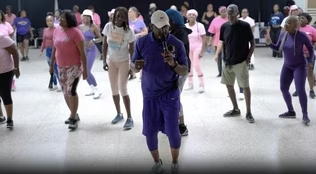
ALESSANDRO DE PALMA: Sharon Johnson is one of the many people working through their trauma with each step of this line dancing class.
SHARON JOHNSON: I was going through a lot of grief.
I didn't know how to deal with it.
I didn't know where to put the feelings I was feeling.
I didn't know how to cope with it.
Some of the things that even my grief counselor suggested was finding a hobby.
Once I found out about the line dancing, I thought that would be somewhere, because I can express myself.
The things that I can't talk about, I can express it through dance.
ALESSANDRO DE PALMA: The classes are run by the Circle of Brotherhood, a nonprofit organization based in Liberty City, Miami, a neighborhood which has historically seen high crime rates.
Their goal is to help people dealing with grief and trauma, including victims of gun violence or those like Sharon, coping with any kind of pain and loss.
SHARON JOHNSON: I've seen people line dance going to parties or clubs and seeing them doing it.
It was intimidating at first, but it turned out to be just what I needed.
ALESSANDRO DE PALMA: Every Wednesday and Saturday, coach Darryl Thomas can be seen grooving to the music.
DARRYL THOMAS, Wellness Coordinator, Circle of Brotherhood: Dance kickin' therapy is the community coming to relieve their stresses, their traumas through line dancing.
This room will pack out real quick.
It's going to be a lot of participation from the young to the young at heart.
I think our youngest line dancer is 8 and our youngest at heart is 91.
ALESSANDRO DE PALMA: And Thomas says he came here after learning that he was injured.
DARRYL THOMAS: So I went to the optometrist and found out I had a detached retina.
It happened out of the blue.
They didn't want me doing anything because of the strain, right?
So I said, well, what am I going to do?
I'm an active person.
I play pickleball.
I play golf.
I do all these things and I couldn't do those things.
I said, what can I do to continue to move around and be active?
Line dancing.
It started out with 25 people.
Now we're up almost to 60 people per class because the word was spreading through social media, through our Web site, through word of mouth.
ALESSANDRO DE PALMA: And the impacts of line dancing are felt in every step.
According to a study this year, line dancing benefits mental health in communities by bringing people closer together, encouraging dancers to support each other outside of the classroom.
SHARON JOHNSON: This is a type of therapy that can help you express yourself, place your grief or your -- whatever it is you're going through.
It may not be grief, but whatever you're going through, and know how to deal with it.
I've been through a lot, and I can tell you life is very short.
So the time that I have here, I want to enjoy it and I'm going to enjoy it through dance, line dancing.
ALESSANDRO DE PALMA: For PBS News Student Reporting Labs, I'm Alessandro de Palma in Liberty City, Miami.
GEOFF BENNETT: Great story.
That's the "News Hour" for tonight.
I'm Geoff Bennett.
Thanks for spending part of your evening with us.
Can tapping into oil reserves help stabilize prices?
Video has Closed Captions
Can tapping into oil reserves help stabilize prices? (6m 17s)
Group turns line dancing into therapy for grief and trauma
Video has Closed Captions
Miami group turns line dancing into therapy for grief and trauma (3m 25s)
How Trump's SAVE America Act would reshape voting
Video has Closed Captions
How Trump's SAVE America Act would reshape voting (6m)
How Ukraine is helping the U.S. defend against Iran's drones
Video has Closed Captions
How Ukraine is helping the U.S. defend against Iran's drone attacks (5m 38s)
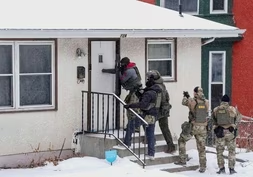
Immigration crackdown sparks fear in people legally in U.S.
Video has Closed Captions
Minnesota immigration crackdown continues to spark fear among people in U.S. legally (7m 54s)
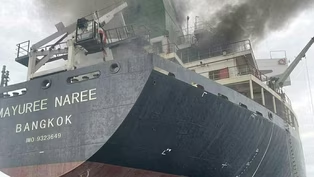
Iran targets ships in Strait of Hormuz, raising energy fears
Video has Closed Captions
Iran targets ships in Strait of Hormuz, raising global energy fears (5m 9s)
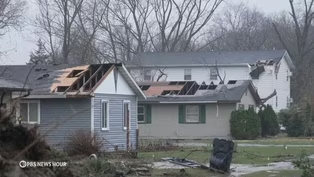
News Wrap: Tornadoes kill at least 2 in Indiana
Video has Closed Captions
News Wrap: Tornadoes kill at least 2 in Indiana (4m 51s)
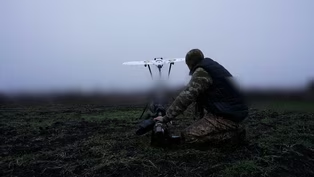
Ukrainian troops share lessons on stopping Iran's drones
Video has Closed Captions
Ukrainian troops share lessons learned from fighting Iran's Shahed drones (5m 5s)
Providing Support for PBS.org
Learn Moreabout PBS online sponsorship
- News and Public Affairs

FRONTLINE is investigative journalism that questions, explains and changes our world.

- News and Public Affairs

Amanpour and Company features conversations with leaders and decision makers.












Support for PBS provided by:
Major corporate funding for the PBS News Hour is provided by BDO, BNSF, Consumer Cellular, American Cruise Lines, and Raymond James. Funding for the PBS NewsHour Weekend is provided by...