
Old Ways, New Thinking
Season 2 Episode 5 | 24m 1sVideo has Closed Captions
The resurgence of the dance hall. A cattle company reinvents a ranch-to-retail model.
The resurgence of the modern dance hall sparks a newfound love for two-stepping. Meanwhile, a cattle company reinvents a ranch-to-retail model.
Problems playing video? | Closed Captioning Feedback
Problems playing video? | Closed Captioning Feedback
Production Support Provided By: Riptide Waters LLC; Texas Parks & Wildlife Foundation; Texas Rural Funders, H-E-B”
Old Ways, New Thinking
Season 2 Episode 5 | 24m 1sVideo has Closed Captions
The resurgence of the modern dance hall sparks a newfound love for two-stepping. Meanwhile, a cattle company reinvents a ranch-to-retail model.
Problems playing video? | Closed Captioning Feedback
Where to Watch Texas Monthly Presents: The Story
Texas Monthly Presents: The Story is available to stream on pbs.org and the PBS app.
Providing Support for PBS.org
Learn Moreabout PBS online sponsorship- [Daniel] This is a Texas story with deep roots.
- Traditions don't come out of nowhere.
They're made.
- [John] You got to be able to adapt, and I think that's all I was doing.
- It's the most Texas thing there is.
Dancing on a Saturday night.
- I just didn't want to be another cattle truck.
I wanted my cattle to mean something.
- Genuinely, this changed my life.
- It's about finding yourself, your own kind of joy.
(soft country music) (bright inspirational music) (keys clacking) (insects chirping) - This is a Texas story with deep roots.
There are a lot of big, famous ranches.
You know, they just don't get passed on to the fifth generation.
They end up breaking up and, you know, the land getting sold off.
They need to continue to innovate to stay relevant.
I'm Daniel Vaughn, barbecue editor at "Texas Monthly," and I wrote "Herding the Next Generation."
The beef industry is my life, right?
Like, Texas barbecue is beef barbecue, and the beef's got to come from somewhere.
(insects chirping) First time I ever heard of 'em was an email from John saying, "Hey, you missed us.
I think you should come out and try our beef."
- We got these cows up in the trap and their calves and we're gonna get 'em up and brand some calves this morning.
- [Daniel] The Scharbauers are a multi-generational cattle ranching family.
Having a fifth generation cattle company still run by the family is really rare.
(cows mooing) They started their ranch back in 1883.
So Chris Scharbauer is the fourth generation of the Scharbauer Cattle Company.
When he came in, it was really just Hereford cattle.
And he decided that really as the cattle industry was shifting towards black cattle or Angus cattle, he wanted to introduce those bloodlines into the Scharbauer cattle.
- Genetics is everything.
We had all Herefords until I came on board and I put an Angus bull on the Herefords.
Got a F1 cross, a Black Baldy.
- His dream was to see the Scharbauer Cattle Company's beef on a menu at a white tablecloth restaurant.
(cows mooing) John Scharbauer is Chris's son.
- We're gonna get this branding equipment and then go in there and start branding.
- John saw a problem.
The young heifers that they were breeding on the ranch, the larger the calf, the really the harder the birthing is.
And so he was trying to find a way to get smaller calves.
He saw a Wagyu calf and he saw how small it was.
Wagyu is a breed of cattle that comes out of Japan.
And he thought, "You know, maybe we could try that cross-breeding."
It wasn't something that they had tried before, but John wanted to prove himself.
- I just didn't want to be another cattle truck going down the highway.
I wanted my cattle to mean something.
- The percentage of cattle raised in Texas that are a Wagyu or a Wagyu cross, it's a really small percentage.
So I don't think John expected much out of it.
But when he saw the beef that it was producing, he, well, he got his hopes a little higher.
All right, we got a nice rib eye here.
We got that beautiful marbling from the Wagyu in here.
We got a choice rib eye.
- Nothing wrong with that.
- From a fine grocery store.
This is what you're gonna get in just about every grocery store out there.
And you can see the difference in the marbling.
Like it's just, it's so evident just looking at it.
We cooked 'em up all on the same grill, all the same temperature.
It was so obvious.
It was so obvious how much better John's beef was than the rest of it.
Is this really even a test?
- I mean, I didn't want to say anything.
He cooked it good.
Could've gone a little longer, but not.
(laughs) - The main thing that John was after was these small calves that the Wagyu bulls produced.
And that's what happened.
But they produced some really incredible beef.
That was sort of a byproduct.
They were raising all this great beef from this Wagyu cross, but then how did they get the value out of it?
Well, they needed somewhere to sell it.
And so he decided to open up Midland Meat Co., a meat market in Midland in 2015.
When he first opened up Midland Meat Co., one of his first customers came in, saw the price, and he said, "I'm not paying any price per pound that's higher than a barrel of oil."
- I'm selling a premium product and I want it to be that.
I'm very particular on the quality of the product.
- Really, all the risk is on him now.
The idea that he would open up a place called Midland Meat Co.
just selling the beef from their ranch, like his payday only comes once customers come in and buy the beef out of his case.
- I think the money's in the retail.
And if we want to go another six, seven generation, then we've got to find a way that does that.
And this is the way that I've found that'll work, is taking the meat all the way to the end.
Hey, Danny.
Hey, y'all.
Yeah, we got some prime rib in the case.
Wrapped up, bone in.
These Denvers are real popular.
That's a popular cut here.
You got obviously a rib eye, which is king, especially here in Texas.
But you can see the marbling.
These big streaks are cool, but the little ones that are in there real tight, like this area right here, that's what's gonna give you flavor and tenderness and up your quality.
So the more that you see in the product, the higher quality the beef is.
It tastes beefy with the Wagyu tenderness and a little bit of the buttery flavor that the Wagyu breed gives you.
- So selling steaks out of Midland Meat Co.
was not a challenge.
It was the rest of the animal they needed to sell as well.
- The idea of not moving product, it really bothered me.
With our Wagyu beef, the quality's there.
So I was like, "Well, let's cook it."
- So they opened up The Half Acre, a barbecue restaurant on the north side of Midland where they were able to use a lot of the beef on the menu.
Midland, you're in the middle of oil and gas country.
But you know exactly where you are when you pull into the parking lot of The Half Acre.
Every vehicle on that parking lot is a white pickup truck.
- [Aaron] Usually about 10:30, you're gonna see a lot of oil field trucks start showing up.
A lot of white trucks.
If you don't get in line first, you'll be out there towards the curb.
You might be 50 or 60 deep.
So when they see one guy go, all of a sudden they all want to go.
Oh, the flavor of this beef is unreal.
It's got a great Texas beef with a little bit of, little bit of Wagyu kick to it.
(soft country music) Everything we do has a flavor that you can't replicate.
As soon as the doors open up at 11 o'clock, the restaurant is popping.
- We run our line more like a restaurant than a barbecue joint.
We try to push it out because what we're known for is the fact that we can get them in and out on their lunch break and they're not having to wait.
- Two captains and a special.
(indistinct chatter) - Hello.
- How are you?
- Good.
How are you?
- I'm doing great.
- Good.
Is this for here?
- It is for here, yes.
Don't judge me on the quantities though.
- I won't.
- All right.
I'd love a green chiliburger, please.
- Okay.
- And then I'll also have a three meat plate.
- Yes, sir.
- And pork ribs for sure.
Their pork ribs are fantastic.
Also, their sausage, which they make from Midland Meat Co.
beef.
And then they always have some beef cut from Midland Meat Co.
that they incorporate into the menu.
- [John] You know, we take pride not only in the quality, but also in the cleanliness of our food.
And I want to control every step of that from the, you know, I say conception to consumption.
- This business model, you know, from ranch to retail or conception to consumption, whatever you want to call it, is really unique.
And John decided to do that.
He decided to make that change in the ranch because he saw the great quality of beef in the Wagyu cross that he produced.
We put them in our top 50 for a reason.
The barbecue at The Half Acre is great.
But John's dad, his dream was to see the Scharbauer Cattle Company's beef on a menu at a white tablecloth restaurant.
- John called me and he said, "Dad, I want you to come to New York."
I said, "You bet, John."
I was ready to go.
I flew into Manhattan.
He said, "I want to meet you at Daniel's tonight.
It's a restaurant and it's coat and tie."
And, "Okay."
I opened up the menu and in the entrees, it said Scharbauer Ranch Beef.
That's the first time I'd ever seen the name on a menu.
I looked up.
John was looking straight at me.
That's why he wanted me there.
- And I just asked him, because I knew what his dream was.
And I just asked him, I said, "Dad, what color is that tablecloth?"
And he said, "That's as white as it gets."
And right there, it was awesome.
- It's one of the finest restaurants in the world.
I had tears in my eyes the whole time we ate.
- [Daniel] I mean, to me, the story is about a ranch and a family and about the innovation required to allow it to continue for future generations.
- You got to be able to adapt and change, and I think that's all I was doing, was adapting.
My family's motto's, "Leave it better than you found it."
And that's how we tried to run not just our ranches, but our families, our business, anything.
(cows mooing) (upbeat country music) - I think we're gonna be talking about this the way that older generation talked about Studio 54 and doing disco.
Or, "I was there at Woodstock and I saw these artists and I was part of this moment, this rock and roll moment."
That's what's happening right now.
And that's what I think all of us are gonna look back on.
Like, "I was there for the honky-tonks.
I was there."
And it was time to tell that story because it's changed my life.
My name is Josh Alvarez.
I'm a senior writer at "Texas Monthly," and I wrote "The Austin Two-Step."
I arrived in Texas in 2021, and I was here to start a new life, but I wasn't sure if I ever would feel like I'm a Texan.
Somebody said, "You should go to this honky-tonk in Austin."
I showed up and there was really a lot to look at.
The dance floor was just packed.
Everybody in there was just a phenomenal dancer.
I grew up with salsa and cumbia, and dancing in general was just a source of real joy for me.
It was a piece of me that I'd kind of forgotten about.
I asked somebody to dance right away, and from that night on, I was hooked.
(upbeat music) For the better part of 14 months, I was dancing anywhere between four to six nights a week.
It didn't take long for me to pick up on it.
I quickly found out that there was actually this little ecosystem of honky-tonks that they all were regulars at and they would rotate between them.
And the three main ones were The White Horse, Sagebrush, and Sam's Town Point.
There's always been dancing in Austin, and there's always been honky-tonks in Austin.
But this particular scene of these particular honky-tonks, it's never been as popular as it is right now.
And in part, that has to do with some circumstance, specifically COVID and the pandemic, and then the influx of newcomers into Austin.
But it also has to do with some specific people and the things that they have done to make this possible.
Denis O'Donnell is the co-founder of The White Horse and Sagebrush.
He is a long time restaurant and bar manager in the city.
- We saw a special rise and an organic bubbling up of a community of country musicians.
And there was this red hot moment of people in their 20s dancing.
- When I hear honky-tonk, I imagine starch jeans, boots, belt buckles, tucked in shirts.
But you had people with tattoos and piercings, queer people, people who are kind of punks or weirdos.
There's a lot more diversity than I gave it credit for.
- And then I decided with my friends to take a risk and open The White Horse.
The first night, it was packed, and there's all kinds of people.
And it was like, "Wow.
(laughs) Okay.
This is gonna work."
- From that day on, White Horse became the dance scene for this particular kind of community.
- The honky-tonk, two-step, and country music that we have in Austin, it is unique to itself.
It is special.
We are still holding on to traditional styles of country music as it's getting augmented with the times.
We're seeing this thing ever changing and growing.
- One of my favorite things about Texas is that Texas is a dance culture.
There's just this continuous line of generations and generations of Texans who have danced this dance.
(upbeat country music) Two-stepping has its roots all the way back to the dance halls of German and Czech immigrants from the 1800s.
Traditional two-step almost looks like a rhythmic walk.
It's done in a way where you are moving around a dance floor.
And that kind of movement is called progressive two-step.
- The two-step here is a much slower, relaxed pace.
That is your traditional.
- [Josh] Over time, there have been more than a thousand dance halls built in the state.
And they were kind of these community gathering centers for these small towns.
- [Jo Nell] This hall was open in the mid 1870s, and it has not shut down except for COVID.
The dance hall is very special because it holds history.
It holds memories of so many families, children learning to dance here, learning to dance on their dad's shoes.
I grew up coming here and I met my husband here.
- I've been coming here since I was a teenager or so.
I'm 78 years old, so it's going on 60 years or longer.
- It's the most Texas thing there is.
Dancing on a Saturday night, you know, with your kids and your grandparents and everybody.
(upbeat music) - Texas really until recently was a small town state.
So for people to gather together, play music, and then dance together, that was like an essential part of community fabrics.
But by the mid 20th century, Texas was becoming increasingly urban.
And as people flocked there, dance halls have really dropped off.
Today, there are fewer than 400 dance halls operating.
And a lot of them are barely hanging on.
- [Jo Nell] We're losing them quickly.
For a while there, people weren't coming to them any longer, and we've lost many.
And it's sad because that's a part of our history that the door's just shut on.
And you can't necessarily bring that back once it's gone.
- I see more and more dance halls up for sale, and that's been a really sad and hard thing to watch.
I think about my great-grandmother, and I'm dancing to the songs that she danced to.
You know, I get to feel like her memory's alive when I'm out there on the dance floor.
- Dance halls typically attract an older audience.
- Most of our friends that dance with us are 60s, 70s.
- 90s.
90s.
- Yeah, even up to the 90s, our folks are still dancing and we're not seeing kids and grandkids that are coming in to replace them.
- [Jo Nell] And the ones who have shut down, part of their community just died.
And it's heartbreaking to see that.
- [Josh] Meanwhile, honky-tonks really started popping up in cities.
They're smaller typically, and because they're in cities, they get a lot more play.
There's a lot more artists that show up and a lot more dancers too that show up.
And the dance that is being practiced in these honky-tonks today, the ones that I have been hanging out in, it's unique.
It's young people, by and large, and artists that are playing their original music.
It's something that really hasn't been seen before.
- The dance we do in Austin is a regional variation of two-step that I like to call swing in the style of two-step.
- Really, it's kind of born out of necessity.
These are really packed floors, so people have to dance in place.
And then, you know, the creativity that people bring to it, you know, adding these elements of swing and all these combinations, that just seems to have kind of emerged organically over time.
- So our regional dialect, it takes place in about five to 10 bars in this town.
It's kind of its own little spinoff.
It's really cool.
You should take the class tonight.
(laughs) All right, dancers.
Here we go.
All right, so we've got leads on this side of the room and follows on this side of the room.
Anybody can lead.
Anybody can follow.
It's not gender specific.
And what we do in this town is a regional variation of Texas two-step.
So we're gonna take a dance that you might have learned as a kid, but we're gonna show you how it fits small dance floors.
- [Josh] Vanessa Vaught is the founder of Double or Nothing Two-Step, which is the most influential two-step dance instruction company in the city.
She took it upon herself to formalize instruction of the Austin style of two-stepping.
- [Vanessa] So this is the part where you got to be brave, walk across the room, ask a stranger to dance.
Since the pandemic, there's just been a huge upward trend in people wanting to learn our local social dance.
- [Josh] Without her really meaning to, she's kind of created this community.
- It's also being picked up by communities around the world.
There's a woman in Tulsa, Oklahoma teaching this.
Melbourne, Australia, Brooklyn, New York, London, England.
They come here and learn this dance.
It's really hard not to get obsessively involved in what's happening here, and then they take it to where they live and start to teach it too.
I always recommend people that are new to town or perhaps recently single, if they're trying to get out and make new friends, I don't know a faster way than learning to two-step, especially in Austin.
- One thing I do love about the community is the diversity.
Like I'm constantly talking to people of all ages and dancing with people from all backgrounds.
- Our queer community here in Austin loves to dance.
And here we are, inside of a place that was built in the '40s, where everyone is welcome.
- Whether they're native Texans or newcomers, they're showing up and they're discovering the joy of dancing, but also the joy of just being around other people and getting to meet every night somebody new.
That allows people to become a part of the fabric of the city and a part of a broader culture and that's exactly what happened to me.
I became a Texan because of dancing.
I also felt after about a year of dancing that I was ready for a relationship.
I was ready to really find somebody who was serious and I just knew that I was gonna find that person dancing.
That first dance, I just started asking her some questions and we just kind of fell into talking.
- He didn't spin me one time, after three dances consecutively.
(laughs) So that was enough to give him my number.
- So that was how I met Allie.
I owe dancing a lot.
I found my own happiness, and that's something that I can't even wait to impart upon my daughter when she's old enough to stand.
- [Jo Nell] When you're dancing and you just look at everybody having a great time, your worries leave.
- [Vanessa] It really does feel like pure joy.
It's like serenity.
- [Denis] It's about the human connection.
It's about having a visceral human connection here.
- Texans have their traditions and those are important.
But at the same time, traditions just don't come out of nowhere.
They're made.
And we're making our own here too.
This is something that we're participating in and making for ourselves.
(bright inspirational music) - Today's innovation is tomorrow's tradition.
And they need to continue to innovate to stay relevant.
- [Josh] The things that we think of as traditional were themselves a result of blending ideas and cultures.
And that's all that's happening here too.
That's part of the story of Texas and will continue to be.
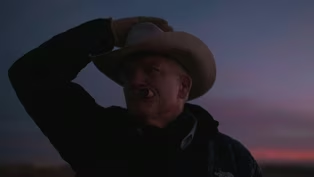
Old Ways, New Thinking Preview
Video has Closed Captions
Preview: S2 Ep5 | 30s | The resurgence of the dance hall. A cattle company reinvents a ranch-to-retail model. (30s)
Providing Support for PBS.org
Learn Moreabout PBS online sponsorship










Support for PBS provided by:
Production Support Provided By: Riptide Waters LLC; Texas Parks & Wildlife Foundation; Texas Rural Funders, H-E-B”