
Pacific Mother
9/17/2026 | 55mVideo has Closed Captions
Indigenous women around the Pacific seek support in their birth choices.
As freediving couple Sachiko Fukumoto and William Trubridge navigated maternity systems for the birth of their first child, it awoke in them a fierce realisation about the lack of choice many parents face. Now Sachiko connects with other mothers around the Pacific, from Hawai’i, Tahiti, the Cook Islands, and Aotearoa who face similar battles and have been cut off from Indigenous birth practices.
Problems playing video? | Closed Captioning Feedback
Problems playing video? | Closed Captioning Feedback
Funding provided by the Corporation for Public Broadcasting and the National Endowment for the Arts.
Pacific Mother
9/17/2026 | 55mVideo has Closed Captions
As freediving couple Sachiko Fukumoto and William Trubridge navigated maternity systems for the birth of their first child, it awoke in them a fierce realisation about the lack of choice many parents face. Now Sachiko connects with other mothers around the Pacific, from Hawai’i, Tahiti, the Cook Islands, and Aotearoa who face similar battles and have been cut off from Indigenous birth practices.
Problems playing video? | Closed Captioning Feedback
Where to Watch Pacific Heartbeat
Pacific Heartbeat is available to stream on pbs.org and the PBS app.
Providing Support for PBS.org
Learn Moreabout PBS online sponsorshipNATIVE: We are all connected.
NATIVE: When the forests disappeared, we lost our homes.
NATIVE: We lost a lot of our cultural practices after colonization.
NATIVE: But now we're trying to get things back.
IWALANI: Through your art form, people will see your humanity.
NATIVE: We will do whatever it takes for the many generations to come.
♪ ♪ ♪ ♪ ♪ ♪ SACHIKO: We are all connected parents, babies, ocean, and the earth.
And when we forget that, everything suffers.
♪ ♪ ♪ ♪ I'm Sachiko Fukumoto, an actress and freediver from the island of Okinawa in the Northwest Pacific.
My partner William, is a world champion freediver from Aotearoa, New Zealand.
We met at a freediving competition in the Bahamas and now, we spend our lives in and around the ocean.
♪ ♪ Because I surf, because I dive, I'm aware of the tide, or like the moon, and just all this natural cycle.
And I think the more you put yourself into that nature, like being part of the, the Earth, your instinct will get sharper.
I feel like that's the most natural way to live.
♪ ♪ As soon as I knew I was pregnant, all I thought of was, "Okay, which sea can I give birth in?"
You know that was like my only option.
(underwater sounds).
We did a lot of research into ocean birth.
The water has to be warm enough to stay in for a long time.
And obviously, it has to be clean.
And we needed a medical facility nearby for backup.
When we couldn't find a place that tick all the boxes, we had to give up on our dream of an ocean birth.
As soon as we decide, "Okay."
Like, we crossed this option off, we carry on and, and look for the next option, which was home water birth.
♪ ♪ But the system in Japan makes it really hard.
Nearly all women go to the hospital to have their babies.
I told our doctor that I wanted to give birth in water, and she looked at me as if I was crazy.
♪ ♪ So I went to a midwives clinic.
They really wanted to help but I was 36 years old already.
I guess in English, it's a high-risk pregnancy?
But in Japanese, they call it (speaking in native language).
Which means old pregnant woman or old woman giving birth.
So the midwives thought that I would probably be taken to the hospital anyway.
I was so shocked that we couldn't plan the birth we wanted.
I mean, I'm the one who's giving birth, why can't I decide how I'm going to do it?
And then, as I was talking with the midwives there, they were like, "You know what?
You should go to New Zealand.
If you're very clear on the labor that you want to do, then that's the place to go."
I start to do more research on that, and I start looking into the you know, the midwife, find your midwife website and everything until I found the midwife that I liked, which was Julie.
And by then, I was, I think, seven or eight months pregnant already.
♪ ♪ ♪ ♪ JULIE: You're just lucky that you fell in love with a Kiwi.
SACHIKO: Mm-hmm JULIE: Cause that means you can come here.
We have community-based midwives and we have hospital-based midwives and they work together to care for women, to keep, you know, everything as normal as possible, and as safe as possible.
And, there is a lovely flow for me if I'm at a home birth and I'm concerned about something or there's a change and we've decided we need to transfer into hospital, it's only a phone call and these people accept us, and want to hear what we've been up to and will take over the care if required.
So, this is... is an ultrasound that makes a noise.
(ultrasound heartbeat).
Oh, there's your baby, very easy.
So perfect.
SACHIKO: Mm-hmm.
JULIE: One of the joys of continuity care is seeing the same midwife frequently so that I get to know your tummy and your baby.
Hello darling.
(laughs).
So we get to talk about how your baby's feeling, which way it's lying, working towards, you know, heading towards the birth, and the baby is putting on weight, and is in a good position.
SACHIKO: Okay.
I felt like I knew her for a long time and just felt like she was a mother or a family.
I was just relying on her, like a 100%.
♪ ♪ (pained moan).
(breathing heavily).
(moaning).
It's okay, it's okay... (breathing heavily).
♪ ♪ (grunting).
(pained screams).
♪ ♪ (water splashing).
JULIE: Oh, look at you with those big eyes.
(infant crying).
WILLIAM: You've been inside there haven't you.
(infant crying).
Little cutie.
It's your birthday!
SACHIKO: Mm-hmm... (speaking in native language).
WILLIAM: Is she ready?
SACHIKO: Yeah.
WILLIAM: Okay, let's go.
Oh, watch out.
(wave splashes).
♪ ♪ How's that Lena?
That's the Pacific ocean.
(seagulls cawing).
SACHIKO: I'm so grateful to Julie for supporting us.
But why did we have to fight so hard to get the birth that feels so right?
To understand more about New Zealand's maternity system, I talked to one of the women who helped create it.
KAREN: My friend said, "Why don't you go and be a midwife?"
And I thought, "Oh, I could be a midwife, I've had babies" So off I went, and I was shocked, actually at what we did to women.
This is like in 1977.
And I, I just felt something was really wrong.
It wasn't done properly.
Women were laboring by themselves.
We weren't allowed to bring the fathers in.
There were all sorts of things wrong with the system.
New Zealand women were cross about the maternity system.
There were a lot of New Zealand women in the 70s who were in the Women's Health Movement.
And they wanted change.
It's women who actually are confident in their body and have a sense of identity and a personal authority.
So, what is it about maternity that we all think we can do better than the woman?
When I went to Japan in 1990, I was very privileged to spend a lot of time with the elder midwives who were average age 70 to 90.
They told me about how they worked previously from the maternity houses.
And so, they took me to the maternity houses and I was just amazed!
It was beautiful.
Beautiful.
And here we are... SACHIKO: Wow.
KAREN: 40 years later, and Japan's lost that knowledge.
SACHIKO: So is it correct to say that you went to Japan and got that idea... KAREN: Inspired.
SACHIKO: Inspired... ...by the Japanese midwife and then you kind of brought it back to New Zealand?
KAREN: Oh, I thought, "Well, you see?
Japan can do it why is New Zealand not doing it?"
But it just seems to me that, now we're here talking about how how can Japan do it.
It's like, why did Japan lose it?
And so all of us, all of us women in every country have lost a lot of our own personal birthing knowledge.
And so, I just think it's time we got it back and it's a fight that we still have to fight.
SACHIKO:Right.
Still a long way to go.
(laughing).
And so, I decided to share my birth story online.
After that, I began to hear from women all over the world.
♪ ♪ And then one day, Kimi reached out to me, Kimi, who is my big idol I admire her so much.
♪ ♪ She was just asking me all the question about diving while I was pregnant.
I finally asked her, "If you're pregnant?"
And she was like, "Yes!"
I was curious how was her birth plan, and then I was so shocked because obviously, she was really struggling with the system and I was like, "I want to help her.
I want to do something for her, And I felt like I had to go to Hawaii to talk to her.
♪ ♪ Hello!
KIMI: Something about diving just pacifies him, and then he wakes up later, like... SACHIKO: Like "Go back in the water!"
KIMI: Yeah.
I'm like a chronic optimist, like I always believe that everything's going to be fine.
And then when I became pregnant, gosh!
And so just from the moment you find out that you're carrying this precious cargo, you can't help but, I could not help, but start second-guessing everything and being like, "Am I doing it wrong?
Am I doing it right?"
♪ ♪ Hearing what you had gone through to really kind of fight for a natural birth, I think I've always wanted it, but there's just so much fear based around it and so much fear being fed.
It was almost like a secret where I didn't want to tell anybody that that's something that I wanted because just don't want to hear all the negative comments, and you don't want to hear everyone say, "Oh, that's so scary."
Or, "Oh, what if?"
So I just stopped talking about it, you know?
And I just figured that you know the hospital would be the only real safe way to go and that any wishes or curiosity even, that I had about something different was to be kept to myself.
♪ ♪ To hear that, for every no that you were told, you just kept going until you found a yes, that gave me the strength to say, "Okay, I can take just another step."
One step just led to another step, led to another step and before I knew it, I was sitting down with a little casual interview with Ye, who's now my midwife, it was just, a click that I just, like I knew.
SACHIKO: Aw... KIMI: So, yeah.
YE: Hi, Kimi.
I'm here!
I'm going to measure your mama's tummy and see how big you are.
JUSTIN: Just the whole empowerment thing.
Like, I feel like you are really empowering Kimi, that's the most important part of the relationship, I think.
So, it's just really from you encouraged her to just you know, choose her path and empower herself, you know?
Let her make the decision.
YE: At this point, your job, is growing this baby.
KIMI: Mm-hmm... ♪ ♪ (heartbeat thumping).
KIMI: A lot of the answers, we need to give credit to the past and we need to kind of look back at some of the traditions that came before us that might not be as abundant now, but I do think that there's some ancient wisdom in the way women have been giving birth for thousands of years.
SACHIKO: On these Island, there is a woman who is helping to bring tradition back to the community.
SHARON: We lost a lot of our cultural practices after colonization where it became kind of in style to go to the hospital because that's what the white women did.
And so, a group of women, we started meeting and we decided to hold these birthing classes for native Hawaiian couples and it was really about empowering our Hawaiian families to bring back whatever cultural practices they wanted to into their birth.
And so, it's taken time now to reclaim them.
You want to hold them for me?
You know what this is good for?
CHILD: What?
SHARON: We make tea with it.
CHILD: Tea with it?
SHARON: Yeah, it's very good for the mom.
For us, whether it's home or in the hospital, giving birth on your aina, means you know the winds, you know the rains, you know the valleys, you know the people around you.
And that becomes your place of birth.
You identify with that.
What we found is that the relationships are better, the communication is better.
They tell us they've become better lovers, better friends, better communicators.
Most importantly, better parents that are going into the childbirth process without fear.
♪ ♪ Over in Tahiti, a friend of mine also had to fight to get the birth she wanted.
♪ ♪ RAVA: I wanted to give birth in nature.
I would sit on the beach and think about my pregnancy and talk about it with Lolo.
And, it all developed organically from there.
I asked friends here in Tahiti if anybody had birthed at home or in water, or in the ocean, or anywhere else but the hospital, and I couldn't find anybody.
MARIANNE: We were not supposed to speak Tahitian when I grew up, we were not supposed to do so many things, but now, we're trying to get things back.
Our culture back and everything back, and Rava, who was born in the United States in the hospital, decided by herself that she's going the way our ancestors did.
That's what she told me.
RAVA: I think that there are midwives that will birth a child at home in France, but that there aren't any in Tahiti.
So, that's when I started asking people in Hawaii.
I had reached out to this close friend of mine and she spoke about me to Jaymie, and then Jaymie and I communicated via email.
And then, I went to Hawaii to go meet her and I, was surprised that she actually thought, I don't know that she actually thought I could birth the way I wanted to birth.
And that maybe it was actually going to happen.
(indistinct chatter).
JAYMIE: So Rava was already pregnant when we met and we talked about what she wanted and, and I told her how I could serve her but that I didn't live there.
So it was, you know, how are we going to do prenatal care?
So I trained her.
At how to listen to her baby, uh, how to take pulses.
I sent her home with urine sticks and we met once a month, online.
And, we did little visits, and we talked about too that prenatal care is not your visit with your midwife or your doctor.
You do your prenatal care.
You make sure you stay healthy.
RAVA: Where's mama's ears?
I felt like I had done what I could to set myself up for success if something went wrong at home, you know?
So, just prepare the right phone numbers, make sure people have phones around, make sure there's transportation and somebody that can drive that transportation, knowing how far away the hospital is.
So, I was kind of aware.
♪ ♪ LAURENT: We were waiting for baby.
It was supposed to come on the fourth and in the end it was the 12th.
We were waiting, trying to get ready.
We are waiting for that kid and please, let us meet him.
RAVA: And then I woke up at 3: 00 a.m., which had been a habit of mine for the last week.
My contractions started and I was on the beach.
I was so hot.
I was sweating and all I wanted to do was get in the water and just sit there and and cool down and I asked Lolo to come with me and I said, "Okay, get down in the water."
And I wanted to lean up against him, but as I started pulling him, I realized he wasn't getting in the water and he looked at me like I was crazy and said, "The water is freezing.
I don't think this is a good idea."
So we moved from the shore to the inside of the house.
RAVA: I like turned into a wolf or something, a monster.
I just remember screaming and pulling on blankets and pushing, and I remember my midwife being at my ear and just like whispering things.
LAURENT: A few moments later, yeah, a moan, a last push and... Baby was there.
Baby was there in my hand.
And... (crying).
I think, I think that was the most magical moment.
You know, at that moment, baby, baby came out, you could start to see the baby face, it goes like... (imitates babies cry).
And life came into that body, and that's how Uvihi was born.
RAVA: Yeah, and we did it.
It was like we did it, because it was a whole community that did it.
I mean, I wasn't alone.
(infant crying).
(Laurent speaking French).
RAVA: After he came out, I felt like the strongest woman in the world.
How could a man ever lay a hand on a woman?
How could... Everybody should just be like bowing down and worshiping every mother.
♪ ♪ SACHIKO: I've also been in touch with Ioana, another ocean woman, to find out about her birth journey in Cook Islands.
♪ ♪ IOANA: That's so cool that you could give birth in the water except that it's not possible here so we would have to travel to New Zealand.
SACHIKO: So there's really no way to give birth at home or in the water in Cook Island?
IOANA: No.
JOHNNY: Yeah, I mean not, not by choice.
IOANA: Yeah.
JOHNNY: Yeah.
IOANA: So, we just we gave birth in the, in the hospital here.
Throughout your pregnancy, there are different nurses in the clinic that you see for your checkups and when you go to give birth, it's whoever the midwives are on duty that you get.
I was fortunate enough to meet the midwives that I ended up with on the night the week before, because I had false labor contractions and they also knew my family.
And I think that made me feel more comfortable.
(background chatters).
(cheers).
SACHIKO: Ioana tells me that family is everything to her as a Pacific Islander and her community is part of her family.
IOANA: I think I had a very positive birthing experience because I was surrounded by people that I love.
(indistinct chatter).
In the birthing room, I had John, my mom, and my paddling coach.
John promised her that he was going to tell her as soon as we went up to the hospital.
She's a very motivating person.
(laughs).
The call for picking up the pace and catching a wave is push, push, push.
So when the midwife would say, "Okay, you can push now."
She'd be like, "Push, Ana!
Push!
Push, push!"
And like, for a second, I just got you know, it's like I transported back to being in the vaka.
JOHNNY: To be there for the moment when Maiata first came into the world.
You know, it was one of the most special experiences of my life.
SACHIKO: Are there like, traditional way of giving birth or maternity care in Cook Islands.
IOANA: You don't really hear much about the traditional methods of, of giving birth.
JOHNNY: It's, it's pretty westernized now.
IOANA: I'd hear about what it was like with my Nana.
She gave birth in the hospital for all of her eight births but before her, I've always wondered how it was like for them, like for my grandmother's grandmother maybe.
I have a relative, Mama Niki.
She grew up on the island of Manihiki, where she later returned to be the nurse there.
She might know what it was like back then.
NIKI: In days of old, if I could go back to my mother having her children, Manihiki had men who delivered babies and old Papa, Papa Kaiavaava, he was known as the, what we would say today, the midwife.
My father told me he delivered my mother's children by my mom sitting on his knee facing that way, with him pushing on her, on her back.
IOANA: Her back, yeah.
NIKI: Lower back and helping her on a, on a during a contraction to push the baby out.
IOANA: Yeah, so, after the baby's born, what do they do with the placenta?
Do they, do they, they take it home?
NIKI: Beautiful tradition.
So, each child who's born in Manihiki has a coconut tree.
Yes, the placenta is given to the parents and they plant a coconut tree on it because a coconut tree provides all forms of survival, with food and shelter and, anything you can think of.
♪ ♪ SACHIKO: It's so interesting to see how customs were spread by the migration of people all over the Pacific.
Back in Aotearoa, New Zealand, I've connected with a Maori midwife, Lisa, who is weaving traditional knowledge with modern birth care.
LISA: Within my own practice, I teach traditional Maori birthing practices.
For me, it's probably about whakapapa, which is connection to the land, to the moana, to the ocean.
So, it's, it's our connection that we have with all the realms, not just physical but spiritual and mental as well.
Hapu wahine, for Maori, are considered sacred or tapu and we were really looked after and protected by our elders, by the whole village, by the whole tribe.
When they went to have their pepi, they would leave the village and they would go away to another place with their birthing attendants that would help them deliver the pepi, then they would go back to the main village after a week.
Everything where they gave birth was all buried and that area was tapu.
(birds chirping).
Colonization has lead women to believe that it was a dirty subject to not to be talked about.
So, you know, during that time of colonization actually, they weren't allowed to take their whenua.
The whenua got burnt at the hospital.
SACHIKO: What is that?
LISA: The placenta.
SACHIKO: Wow.
LISA: Yeah.
So, the word whenua means land on which we stand and we nourish, and we get our sustenance from, as is the name of the placenta is whenua.
So, that's where the pepi also gets its sustenance, and its nourishment, and its life force, and its Mauri, that essence, that spirit.
They get that from the whenua as well.
SACHIKO: So land and placenta is the same word?
LISA: Yeah, so, yeah land and placenta is the same word.
SACHIKO: That's so beautiful LISA: Yeah, also, our womb or our uterus, our kopu, with the baby grows is called Te Whare Tangata which is house of the people.
And that also is reflective of our Marae.
When we go to our Whare Tupuna is the Whare Tangata and both are as sacred as each other.
They hold the stories of the people and they tell of the creation stories between Papatuanuku and Ranginui, So, Earth Mother and Sky Father.
When the baby first comes out, the cord is really blue.
Dark, dark blue.
It's got all that oxygenated blood running through it.
I've been using muka for over 20 years.
All of my clients use muka and they don't really go for the clamp and I'll show you how to tie it.
So, the pito rots off.
It'll take only 3 to 5 days, generally to heal and fall off.
For Maori, it's really important that we return our whenua back to the whenua.
So, whenua ki te whenua.
That is why we're going to make this vessel, or this ipu today, so your whenua goes straight from the birth, into the ipu, into the ground.
Okay?
So, wherever you choose to bury your whenua, it needs to be of a significant place for your pepi.
And they will always go back to where their whenua is.
(singing in native language).
IOANA: In Cook Islands Maori, the name for placenta is "enua" which also translates to "land" in English.
My nana tells me that for a long time, the women in my family have always used the rara leaves after giving birth.
And then do you cook it or...?
ELIZABETH: Put it in the pot, boil it.
After that, pour in there.
In the basin, in the... bath.
And sit in, sit in the bathtub where this thing is.
IOANA: To heal them and clean them out?
ELIZABETH: That will clean them out and that will mend your broken pieces, your broken... what you call, vulva.
IOANA: So, when you gave birth Nana, did you bring the pito home?
The pito and the placenta?
ELIZABETH: Yes, I brought the placenta home and bury it somewhere.
Only that the pito from the pito here, it's dry.
IOANA: Yeah.
ELIZABETH: You put it in the ariri shell and take it.
Give it to someone who goes to, to the ocean.
IOANA: Why did they, why did they do that?
ELIZABETH: They said that so the baby won't get vomit whenever she goes on the... IOANA: The ocean?
ELIZABETH: On the ocean, sailing in the ship or somewhere.
IOANA: They don't get seasick.
Did it work?
I don't know.
(laughter).
♪ ♪ SACHIKO: What did you do with your son's pito?
RAVA: So the pito stayed on Uvihi, I think it fell off about a week later.
dried up and fell off a week later.
We collected it.
We kept it and like a little shell for a while and we decided to celebrate my son's first birthday by giving the pito back to the ocean to strengthen his tie with the ocean.
I mean he was born right next to it.
♪ ♪ ♪ ♪ ♪ ♪ ♪ ♪ SACHIKO: I finally have a chance to catch up with Kimi and Justin in Hawaii.
And since I last saw them, Buddy has joined the family.
♪ ♪ (indistinct background chatter).
How was your birth?
KIMI: I was 38 weeks pregnant, and I just got this funny feeling this morning that I woke up.
And I couldn't pinpoint what it was, and I couldn't quite get to my midwife Ye, because there is traffic that day.
But I ended up going in to a doctor's office, getting my blood pressure checked, and it was just so high, it was just to the roof.
And they told me what, you know, we think you have this, essentially it's a disease, preeclampsia.
It has been the number one killer of babies and moms.
My body was having a reaction to the way that my placenta had attached itself.
It just, things didn't look good.
Like it looked like I was about to have a stroke.
Hearing that the only cure is delivery, let's induce, oh my gosh.
It was like, why did I even come in here?
Why did I even listen to that voice?
Like this is not what I wanted.
And then one of the nurse staff, they just said to me like, "I know you really wanted a home birth and I don't want to take that away from you.
Nobody wants to take that away from you."
And they were like, "But maybe you should call your midwife."
I called Ye, and I just thought if anybody was going to be the biggest advocate of somehow still having a home birth or something like that, it would be her.
But instead Ye just said, "Okay, you need to listen to your baby.
Your baby's already talking to you.
Your baby's already telling you what he wants.
I think he's very much showing you that he can't tolerate active labor."
And then she just said, "Being that delivery is the cure, I actually do support a planned C-section.
Not an emergency one.
That might end up happening anyway if you try to induce, but a planned one.
Let's have this baby."
When Ye said that, I just felt my whole body respond with a yes!
I just hung up the phone and I called the doctors back in and I said, "I'll take a spinal tap and we'll go have a C-section, and I'm going to meet this baby."
And like everyone in that room, it was a team of all women and I just can't even explain it.
Like, we all just woman'd up.
Every single person had such a calm strength.
It was like we were going into a really good battle together.
And Justin was, was right there and it... JUSTIN: Was exciting.
KIMI: It was exciting.
JUSTIN: Yeah.
KIMI: They put up a blue sheet in front of me so I couldn't see.
KIMI: I could watch it.
I could watch Kimi and then peek over and watch it happen.
So it was really like, I had like the best seats in the house, you know?
Because I got to see the baby be delivered, be there to support my wife and it was just super like, full-on special.
KIMI: And of course, I was talking to Buddy.
I was telling him, "Okay Buddy, this is just like when we go diving.
You're going to have to just relax into this and you're going to have to work with Mama."
Then at this one moment, I just heard this collective breath.
And all it told me was, success.
And then it was followed by the most beautiful sound at that moment ever, which was Buddy's cute little cry.
And just his cry.
JUSTIN: And everyone was so... stoked.
KIMI: Everyone.
SACHIKO: That's probably the most beautiful birth story I heard like in the hospital.
KIMI: I think what made the biggest difference that made it a positive birth experience completely was having the right to choose.
SACHIKO: When it comes to birthing, I can see the how and where aren't so important as long as the mother feels safe and empowered.
SACHIKO: While I'm still in Japan, I'm going to see a woman who has built her own traditional birthing home.
She's combining the practices from the past with modern midwifery.
Maybe if we bring back some of our ancestors wisdom, we can enrich our birthing today.
♪ ♪ ♪ ♪ (speaking in native language).
JULIE: Could be a foot.
WILLIAM: Just next to the Bone.
JULIE: Yeah.
(indistinct chatter).
(laughter).
Would you like to press the button?
CHILD: Yes.
(chuckles).
JULIE: Awesome, make the machine go.
It's the Bubba, special microphone.
♪ ♪ (heartbeat whooshing).
LINDA: Let's try put it up on top, in a volcano.
Mummy is making a noise, because she's having a baby.
(distant moaning).
JULIE: Is that a bikkie?
(heavy breathing).
JULIE: Is that your lunch?
(indistinct conversation).
(breathing heavily).
JULIE: It's like a bath.
WILLIAM: In a minute Mila, mummy's going to do some pushing.
(moaning).
WILLIAM: Give mommy a kiss on the cheek.
(moaning).
WILLIAM: She's doing good, isn't she?
JULIE: It's coming.
BEC: It's coming.
JULIE: A bit more every time.
WILLIAM: Yeah, I can feel it stretching.
BEC: It's a good process to be in that, sort of steady.
You don't want from in your tummy to born, it's not good for you or the baby.
Okay?
So, it's just coming down a bit more.
It should (inaudible).
SACHIKO: Ow, ow.
(moaning).
WILLIAM: I wonder if this is your brother or your sister?
SACHIKO: Hi.
(baby crying).
JULIE: 3:17.
(breathing heavily).
Hi.
WILLIAM: It's your little brother.
You've got a little brother, but he is sleeping already, because he had to work hard to come out.
JULIE: It's such a sweet... (bird noises).
SACHIKO: You ready to leave?
JULIE: Ready, steady go.
Pull it all together, Yeah, push it together.
Oh, awesome!
And a bit more?
It's tough you see.
(speaking in native language).
JULIE: Daddy will finish this.
WILLIAM: Okay, you do the first half, I'm going to do the other half.
Hello, here you go.
SACHIKO: She did it, she did it.
Okay.
WILLIAM: Okay, you're free.
(baby crying).
♪ ♪ RAVA: Look, she has a baby.
Can you see the baby in her arms?
SACHIKO: Is he excited about the baby?
RAVA: He loves the baby.
He falls asleep at night on my stomach and he says, "Baby."
And then he puts his hand.
Eh Uvihi?
Baby!
Uvihi, where's the baby?
SACHIKO: Aww RAVA: Right there.
I think he's excited.
I don't know that he understands that the baby's coming out.
SACHIKO: What's your birth plan this time?
Plan is to have a mountain baby, if I can.
SACHIKO: A mountain baby?
RAVA: Well, this one was the ocean baby.
I mean I think that babies have a lot of say, in where they're born also so, I've put in what I would like.
Now, who knows where, where it will actually happen.
SACHIKO: Across the Pacific, to the west of Tahiti, Ioana's 2nd daughter, Mahina, was born in hospital.
(indistinct chatter).
IOANA: Whenever I'm in pain, I always get drawn back to being on the ocean and paddling, because it reminds me that when times get tough and it starts to get hard, it's important to breathe through the pain.
JOHNNY: Baby girl.
(crying).
♪ ♪ SACHIKO: To the north of the Cook Islands in Hawaii, Kimi continues to live at one with the ocean and provide fresh sustainable food for her family.
KIMI: Buddy's middle name is N'au, and N'au is a Hawaiian word for, your gut.
Spiritually, it is this deeper sense of self.
It is where the answers are.
It's your inner guidance, your inner voice, your intuition and also the fact that that is the exact region of my body that he did come out of, I wanted to honor that.
You can have your own piece.
JUSTIN: The biggest piece.
IOANA: Wow.
Birth is a beautiful thing.
It doesn't have to look a certain way to be beautiful.
I am proud to stand with women who have had C-sections and realized like, this did not take away our birthing experience.
I feel so grateful to have had that option.
It still took every bit of working as a team with my baby.
It took every bit of going somewhere mentally, staying calm and riding out the waves.
It was everything.
Birth, the moment I realized this is my birth story and I'm going to do it.
♪ ♪ (speaking in native language).
(indistinct muffled conversation).
We did it.
LAURENT: Welcome, welcome my baby girl.
(baby cries).
RAVA: You're okay, you're okay.
(speaking in native language).
SACHIKO: Rava gave birth on their family land, with her midwife and loved ones by her side.
Her daughter's name is Eruna.
'Eru' means to dig the Earth like the way water carves the riverbed.
And na means she or continually.
So her name is what a river does to the Earth as it flows towards the ocean.
At the southern end of the blue continent, we're following a tradition that stretches across this great ocean.
We are burying our baby's placenta.
WILLIAM: It's growing big, isn't it?
Bigger than you.
You've gotta catch up.
You ready?
Shall we put it in Mila?
MILA: Yeah.
SACHIKO: Okay.
MILA: One, two, three, four, five.
WILLIAM: Here we go, we're going to grow a tree.
SACHIKO: William and I want our children to know that earth and its oceans gave birth to us long ago.
And we're just one of the many creatures to call this planet home.
If our children decide to become parents one day, I hope they will know that birth is a natural part of life.
They will embrace it and they won't fear it.
(theme song "Mai Anamua" plays).
(music continues through credits).
(music plays through credits) (waves crashing).
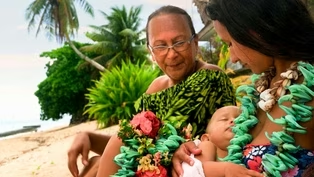
In Tahiti, Rava Ray was Determined to Have an Outdoor Birth
Video has Closed Captions
Rava Ray, Tahitian photographer and artist, sought an ocean birth for her first child. (2m 44s)
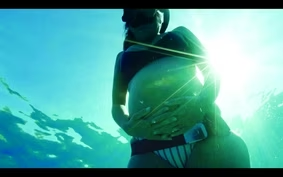
Kimi Werner Shares the Beginning of Her First Birth Journey
Video has Closed Captions
Kimi Werner, Native Hawaiian free diver and spearfisher, shares her first birth journey. (3m 6s)
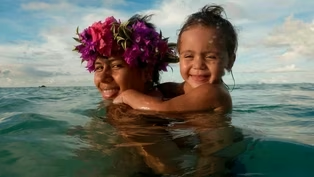
Learning Cook Island Birthing Traditions
Video has Closed Captions
Ioana Turia, competitive paddler and free diver, shares her birth journey in Rarotonga. (2m 33s)
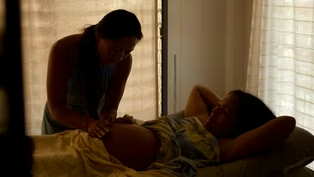
Video has Closed Captions
Indigenous women around the Pacific seek support in their birth choices. (30s)
Providing Support for PBS.org
Learn Moreabout PBS online sponsorship










Support for PBS provided by:
Funding provided by the Corporation for Public Broadcasting and the National Endowment for the Arts.