Pressing Matters
Pressing Matters | MDOC Staffing Crisis, Housing Shortage & Bay City Infrastructure Challenges
Season 3 Episode 2 | 29m 14sVideo has Audio Description
We examine the staffing crisis Michigan's prison system is facing the housing shortage and more.
Michigan’s prison system is facing a crisis level staffing shortage, we're breaking down the issue from all sides. Finding a safe and affordable place to live is harder than ever and the trickle down effect is being felt in communities across Michigan. A look what’s being done to solve this growing crisis. Plus, The driving challenges facing people and businesses in Bay City.
See all videos with Audio DescriptionADProblems playing video? | Closed Captioning Feedback
Problems playing video? | Closed Captioning Feedback
Pressing Matters is a local public television program presented by WCMU
Pressing Matters
Pressing Matters | MDOC Staffing Crisis, Housing Shortage & Bay City Infrastructure Challenges
Season 3 Episode 2 | 29m 14sVideo has Audio Description
Michigan’s prison system is facing a crisis level staffing shortage, we're breaking down the issue from all sides. Finding a safe and affordable place to live is harder than ever and the trickle down effect is being felt in communities across Michigan. A look what’s being done to solve this growing crisis. Plus, The driving challenges facing people and businesses in Bay City.
See all videos with Audio DescriptionADProblems playing video? | Closed Captioning Feedback
Where to Watch Pressing Matters
Pressing Matters is available to stream on pbs.org and the PBS app.
Providing Support for PBS.org
Learn Moreabout PBS online sponsorship- Welcome to "Pressing Matters."
Here's a look at what's coming up next.
(screen whooshing) Michigan's prison system is facing a crisis-level staffing shortage.
From officers and families at their breaking point to state leadership and prison advocates, we're breaking down the issue from all sides to learn what's being done to fill the void.
(screen whooshing) Then, soaring home prices and rising rent payments.
Finding a safe and affordable place to live is harder than ever, and the trickle-down effect is being felt in communities across Michigan.
A look at what's being done to solve this growing crisis.
(screen whooshing) Plus, the driving challenges facing people and businesses in Bay City due to a sudden change in Lansing and unexpected toll issues.
(bright music) - [Melissa] It's these mandates and never seeing your family that are starting to really take a tool.
They did sign up for that job, but they did not sign up to miss their kids' childhoods, to miss the holidays, to miss the birthdays, those kinds of things.
- On paper, Michigan's prison system is a success story.
Populations are at their lowest levels in decades, and fewer people are returning to prison than ever before.
(doors clanking) But a year's long staffing shortage has turned 16-hour mandatory shifts into a daily reality, potentially impacting the safety and well-being of nearly everyone inside prison walls.
Jamie Mankiewicz has the story.
(screen whooshing) - Well, you may be coming in at the start of a shift where normally there would be 60 officers.
And today, you might only have 48, because they're just, we ran out of bodies.
There's nobody left to mandate, and we've got what we've got.
- [Jamie] Byron Osborn has spent more than 30 years working as an officer for the Michigan Department of Corrections.
While serving as the president for the Michigan Corrections Organization, the union representing roughly 6,000 employees across the state, he continues to work at Chippewa Correctional Facility in the eastern Upper Peninsula.
Osborn says the system is running on empty, a situation so dire that in July of 2024, the union requested that Governor Gretchen Whitmer deploy the National Guard to state prisons for support, a request (doors clanking) that was not enacted.
- We've been running anywhere from 800 to 1,000 corrections officers short here for close to a decade.
And we just can't get over the hump to decrease those vacancies.
And that, in turn, is leading to a snowball effect with resignations, people trying to find other lines of work because they can't maintain the pace of the mandatory overtime.
- [Jamie] Those mandates mean many are working multiple 16-hour shifts with constant risks to safety.
- State Rep Dave Prestin last year came on a tour of the Chippewa facility with me.
And while we were in one of the housing units, we had a small entourage of local administrators and stuff.
A prisoner came up, right up to the group we were all in and assaulted and punched out one of the administrators right in front of him.
So he got to see it firsthand.
The warden was standing there and everybody.
So boom, off we had to take the prisoner down, get him out in segregation, and continue our tour.
- [Jamie] In the past few months, St.
Louis Correctional Facility has reported a wave of assaults and disruptions, prompting Lansing lawmakers to hold hearings on how the department reports prison violence.
Robert Greenwood spent more than three decades in the profession and now teaches criminal justice at Madonna University in Livonia.
Greenwood was on the scene of a violent incident in August of 1995 at the Gus Harrison Correctional Facility where seven officers were injured.
He says the staffing shortage is a safety issue for everyone involved.
- Inexperienced staff doesn't have a clue.
They don't have an idea and it's no fault of theirs.
They just don't have the time on the job.
It could turn really quickly, and next thing you know, that person could be assaulted, taken hostage or whatnot.
So it could go from escapes, from serious assaults, to hostage situations really fast.
- [Jamie] Greenwood says one of the keys to keeping the peace is the mental alertness of the staff.
- You might work two or three doubles in a row.
I don't know, you know, what person can function in that type of environment, especially in that type of environment, that you have to be on your A-game all the time, 100% of the time, or you could have or the, you know, repercussions can be deadly.
- [Jamie] But maintaining that A-game is exhausting in itself.
Even when an officer is physically present at home, they're often emotionally a world away.
- When you leave, you could think, "Oh I can do it on the drive home," or if you have another hobby or something.
But it's really hard to turn on and off again.
For instance, sitting down at the dinner table, you're supposed to be asking questions about your kids: "How'd your day go today?
How's class going?
How's sports activities?"
And then in the back of your mind, you're thinking about what happened that day or what you have potentially coming up the next shift.
- [Jamie] Melissa Perron recently announced she is running for state representative for Michigan's 107th District with the MDOC staffing issue as a key part of her platform.
Perron's husband is a corrections officer.
- He is there, but I feel so bad 'cause he's so exhausted.
So it's kind of like having a half parent (laughing) there.
You know what I mean?
Like he's there, but he's exhausted, both physically and, I mean, mentally.
And so it has kind of shifted that two-parent household down to like 1 1/2 on a good day.
My youngest is turning four, and she knows what the word mandate is and what it means and she'll talk about like, "How he's gonna be mandated again.
He's gonna not be home for dinner.
He's gonna miss out on blah blah blah blah blah," or, "We can't go to the beach because Dad's mandated again."
- The Michigan Department of Corrections is stepping up recruitment efforts.
From billboards to broadcast ads, the state has invested over $55 million in bonuses.
New recruits are now eligible to make $73,000 a year before overtime in about 3 1/2 years, along with additional health and dental benefits.
So what does it take to apply?
The department maintains a rigorous entry standard, including educational requirements, a structured interview and background check, and a 10-event physical fitness test and exam.
That's followed by training at an eight-week-long academy before they are assigned to a facility.
Despite the push, the most recent regional academy in the Upper Peninsula yielded just 19 new recruits to be spread across six different prisons.
We sat down with deputy director, Jeremy Bush, who's also a veteran corrections officer.
He's one of those in leadership tasked with filling hundreds of open positions.
- This is a nationwide issue in corrections.
It's corrections industry wide, but it's also an issue in public safety altogether.
And I think it was just exacerbated after COVID, where we've seen large numbers of people either retire or leave at a much faster rate.
- [Jamie] The department is also looking at long-term systemic overhauls.
The MDOC recently unveiled a brand new five-pillar plan: the Safe Prisons Initiative.
It targets everything from technology upgrades to refined prisoner classification.
As part of this initiative, the state is currently shifting resources to manage higher security populations.
Macomb Correctional Facility is adding roughly 190 level IV beds to allow for closer supervision.
Meanwhile, at Chippewa Correctional Facility, where staffing vacancies have been particularly difficult to fill, the department is temporarily closing a level II housing unit.
Officials say relocating these prisoners will reduce the need for mandatory overtime and improve well-being for the remaining officers.
- And what it will do is show more transparency and work on safety and security in our facilities.
People are depending on us.
We can't afford to let up on our recruitment efforts, and we need to be able to demonstrate to people that we're doing everything that we can to get the staff where they need to be.
- [Jamie] It's a strain being felt on both sides of the bars.
(door clanking) - Prisoners are commenting that, "Man, Officer Brown, you look, (laughing) you're not doing well today."
"Well no, I'm not.
This is my third double in a row."
So the entire atmosphere is just strained because the prisoners are under strain because some of their activities are not being covered and ran the way they should.
- [Jamie] Hakim Crampton is a prisoner rights advocate with the nonprofit Citizens for Prison Reform and says the staffing shortage is a concern for those behind bars and their families as well.
Saying in part, quote, "We believe the staffing crisis is partly borne out of low morality among Corrections employees.
We also believe the MDOC is not prioritizing those with the most need for programming and mental health treatment, which exacerbates a high stress work environment that is not safe for persons incarcerated and staff.
We represent families that have loved ones incarcerated in Michigan and they are concerned that the treatment needs of their loved ones are not being met and that the staffing crisis contributes to the lack of program needs being delivered."
Byron Osborn argues, without the return of a pension system, something the state moved away from in 1997, the department is fighting a losing battle.
- And we have people resigning in droves.
I mean, just in the last pay period, at my facility, we had two officers leave to go to truck driving school.
"I'm outta here, can't do it anymore, can't work these hours."
So the attrition is just, the further this staffing crisis goes, the larger the snowball gets of resignations.
Because every time two more resign, that's two more spots of mandatory overtime the next day.
We're just pleading with the State of Michigan and our elected officials to slam the brakes on that.
They've got to take action.
- [Jamie] While the department works internally, a separate battle is playing out in Lansing over a proposed hybrid pension program aimed at improving both officer recruitment and retention.
A bipartisan plan passed both the House and Senate at the end of 2024, but never reached Governor Whitmer's desk.
A dispute is now headed to the state's highest court.
On March 27, the Michigan Supreme Court officially fast-tracked the case, ordering oral arguments to begin this May to decide if those pension bills must be signed into law.
But until a final ruling is handed down, the daily strain on officers remains unchanged.
- Your officer positions are bleeding.
You do not even have the coverage that they need to feel safe.
So if there's more of us speaking out about it and being loud about it and rocking the boat, I'm hoping that it kind of kicks everybody in the pants to get them going, to find the solution.
- [Jamie] For veterans like Robert Greenwood, systemic success is measured by lives turned around and says the staffing issue should be something every Michigander is aware of.
- They should care because it might be their neighbors, their loved ones work in that type of facility, but more importantly, the Department of Corrections is there to rehabilitate prisoners and they go somewhere when they get paroled.
And that could be right next to where you're living.
Do you want somebody that's been rehabilitated, they've learned a good trade?
- [Jamie] As the search for solutions continues, short-staffed facilities prepare for the next shift.
- It bothers me.
I think about the sacrifices our staff make every single day.
These are real-life sacrifices that impact their facility, impact each staff person there, impacts their home life.
It bothers me that they're in that position they're in.
- [Jamie] The personal toll has become an operational reality.
The staff is exhausted and the system is running out of room to maneuver.
- It's pretty dire straits.
(screen whooshing) - We reached out to Governor Whitmer's office regarding the ongoing pension dispute.
A spokesperson for the governor declined to comment, stating, "The Department of Corrections remains the best resource for information on the matter."
This report was produced through WCMU Public Media and the Northern Michigan Journalism Collaborative.
To dive deeper into the staffing crisis, head to pressforwardnorthernmi.org.
- [Amy] Whether you're rural or whether it's the City of Detroit, the shortages might be different, but the impact is the same.
It's making difficult for employers to be able to attract employees to take jobs, 'cause there's nowhere for them to live that's affordable with the income they're going to be making.
- Michigan's housing shortage has reached alarming levels, and the trickle-down effect is being felt in communities across the state.
Current numbers show Michigan is about 119,000 units short of where it needs to be to have enough housing for the current population.
The reality: a broken system leaving vital professions, like teachers, medical staff, and those corrections officers, with job vacancies and families with uncertain futures.
Understanding how we got to this point is as complex as trying to solve the crisis.
(screen whooshing) - We're seeing a lot less young people be able to buy their first time, buy their home for the first time.
In fact, the average age of a first-time home buyer has increased to 40 years old.
It has really increased in our state.
So that shortage is impacting both rural and urban communities, just a little bit differently.
- [Stefanie] Not only is owning a home in Michigan more expensive than ever, finding a safe and affordable place to live is also very difficult and costly.
- The average family can only afford about $173,000 for a home.
It's really hard to find a home in our state that only costs 173,000.
- [Stefanie] And when it comes to new construction, the prices are even more staggering.
- The average cost to build a new home is close to 400,000 now, right?
So that's a big gap between that 173 and 400, but there's also a big gap between the average cost of a home, which is in the 200s, versus what the average Michigan family can afford, right?
And those are homes that are like 1,000 to 1,200 square feet.
Some are on a slab, right?
They don't even include a basement.
So we're not talking really large homes.
We're just talking your average three-bedroom starter home.
- [Stefanie] Now, Michigan isn't the only state dealing with a housing shortage.
It's a nationwide problem.
Amy Hovey with MSHDA tells us it's a problem nearly two decades in the making.
- It started in 2008 when we went through our recession.
Building permits plummeted, and it took a long time in our state for those to be able to creep back up to normal building rates.
Pandemic only exacerbated where we were with housing in our state.
The cost of construction went up.
We've had a labor shortage since the recession.
We also saw more people purchase second homes in our state during the pandemic.
We saw an increase in Airbnbs, short-term rentals in our state, and not just on the coastline where you would typically think we have a lot of Airbnbs, but they're pretty pervasive throughout the entire state.
Michigan is a state that population is aging.
They're not moving out of their homes as they age.
So our household size are shrinking.
So where we might have had four or five people living in a single home, that same home may now have just one or two people.
- [Stefanie] And as the number of available homes began to shrink, rents went up.
- So supply and demand.
As supply was stagnant but demand soared, landlords knew they could ask for more money and get it.
And that's what happened.
In some of our communities, you saw up to 25, 30% increase in rents within just a few years.
And when you think about that, Michigan families, their largest payment in their budget is housing, whether it's a mortgage or their rent.
Most of us couldn't see that go up 30% in a single year and be able to stay in that home, right, or in that housing unit.
- [Stefanie] Leaders with Habitat for Humanity in Cadillac see the need firsthand.
They've stepped up efforts to help deal with the crisis.
They used to build one house a year, but now, they build three.
They also started a repair program to help keep people in their homes safely and affordably.
But there's only so much they can do.
- So in the Wexford County, there was a research study done.
It wasn't all the counties, but that research study showed that in the next five years, we're gonna be 4,000 houses short for rent and for sale.
That's a lot for a town of 10,000 people.
I mean, we need housing everywhere, and I feel like, until we can get some apartment complexes and multifamily housing units and townhouses and those kinda things, we're gonna still struggle with that.
- [Stefanie] Families who are selected to live in a Habitat home must meet certain requirements.
They also go through extensive training, like finance and budgeting.
- They have to have a job.
They have to have a decent credit score.
And they have to have a debt-to-income ratio that makes it work.
So we don't want 'em to fail.
We want people to be able to stay in those houses affordably.
And they have to put in sweat equity.
They have to have a job, you know, two-year job history.
They do have to qualify for a mortgage.
We don't give houses away.
They do have a mortgage.
- [Stefanie] After years of renting and seeing her payments go up, Juanita Custer qualified and moved into a home through Habitat for Humanity in Isabella County last year.
With her monthly mortgage, she now pays less than when she was renting.
- I think when you're renting, you kinda feel like you're throwing your money away.
You're not getting equity.
You can't update the porch, paint, throw a new light fixture up.
So when you're home, you get the rewards.
And I think it just makes you feel good about yourself, the home ownership program.
And once you get out of renting, you really, that's when you start to notice the issue.
- [Stefanie] Solving the housing shortage is complex.
In 2022, leaders created a statewide housing plan to understand different needs for different people and populations.
They're also working to create more regional housing partnerships, provide additional financial assistance, along with encouraging local governmental policy changes.
- And so that's the overlying biggest barrier is the private market is just not working on its own, which really requires the government to get involved.
And it can get involved in lots of ways.
So it can change the zoning and the housing policies in those individual municipalities.
We have a Get Housing Ready guide on our website that really speaks to local governments and says, "This is what you can do as a local government to kinda be pro-housing, to be able to be more attractive to developers."
That might include allowing for a denser housing type, right, more housing units on less land, which does bring down the cost of creating housing.
It might also be allowing for ADUs, for those smaller housing units on an existing lot, right, whether it's above a garage, whether it's a backyard housing unit, you know?
Those adjacent dwelling units really do help us address the housing shortage.
- [Stefanie] The state is also incentivizing apprenticeship programs to boost their labor shortage in construction trades.
It's a path that not only pays well but teaches skills that go beyond the classroom.
(saw whirring) - It's awesome, 'cause I'm teaching a little bit of everything about the house, especially if they have me two years.
You know, you get the framing, the siding, the roofing, electrical, plumbing, heating.
You know, one of these kids are gonna go out and, you know, they might wire my house someday, or they might wire Meijers or Walmart or plumbing.
And it just, you know, it's giving them the skills to help them the rest of their lives, which is pretty awesome.
- I'd rather just work with my hands and be kinda on my feet and active, and also, just use my skills that I learned in trades.
And I do like the money, because I've learned that there's a lotta money in trade.
- [Stefanie] There's no question, without more affordable housing, communities can and will suffer.
It's already happening in schools where positions remain unfilled, putting extra burdens on teachers.
- I mean, I've heard stories of folks accepting jobs, coming to look for a place to live, and then having to say, "I'm sorry.
I can't take this job 'cause I can't find a place to live."
Traverse City is a great example.
We've been trying to work closely with that community in developing housing specifically for their school district, because they're suffering, right?
If you can't get teachers, who's teaching the children there?
We had hospitals apply and receive funding to provide down payment assistance to make it more affordable for their employees to purchase homes.
We know that housing is foundational to other parts of our lives, right?
We aren't gonna have success in education, we're not gonna meet our third grade reading goals if people don't have a place to come to at the end of the day.
We know that stable housing is key to both mental and physical health.
- Here, we know our yard is safe to run around in.
My kids each have their own room here.
And that was a big thing for me.
I'm an only child, so your room, your stuff.
We're close to the schools.
They have friends right down the road.
Now we have a river and a park (water burbling) just across the way, which is where my boys always fished at.
- Everyone deserves that.
It does change the trajectory of a family's life when they have a safe and affordable house.
They're able to look to the future, save for their kids' college, retirement, all those things that are so important that we know, but they're just not able to do until they're safe.
(screen whooshing) - Turning our attention now to the Bay City area, where commuters are facing challenges surrounding infrastructure funding, along with how some of the bridges are being operated.
It's a story WCMU has been following closely.
In late 2025, the state, in an unprecedented move, took back $645 million in allocated spending that was not distributed.
In that budget was about $1.6 million that Bay City was planning on using to make improvements on projects including roads and bridges.
In order to get into Bay City from the north and the west, drivers have to cross one of four bridges over the Saginaw River.
Right now, Lafayette Bridge on the south end of town is closed for construction.
That bridge is free to cross when it's open.
Veterans Memorial Bridge is open and free to cross.
And both Independence and Liberty Bridges are open, but they require a toll to cross.
Now, back with me to get us all caught up on what is happening is WCMU News reporter AJ Jones.
- How you doing?
- Hi, AJ, thank you for being here today.
- Hey, happy to be here.
- Well, there are a couple of issues at play here.
So let's start off with the $1.6 million that was clawed back.
What was the plan for that money?
- So the $1.6 million was going to be spending that Bay City was going to put into various street projects, infrastructure projects.
That money was money that the city had gotten back in reimbursements for its share of the spending on the repairs currently being done to the Lafayette Bridge.
Now, that $1.6 million was a part of the money that got clawed back by the State House, which is currently run by the GOP.
So included in the 645 was something like 370 million in community grants.
That's where the money for the bridge reimbursement was.
And so it's created this hole in Bay City's budget.
Now, I spoke to Bay City Mayor Christopher Girard back in January.
And he told me that the city could potentially just sort of move money that had already been allocated for other things forward in order to make up the margins, but the gist of it was, is that now, there is this gap in the city's budget because of the decision to claw back the funds by the State House.
And there is now a lawsuit over the money between State House leadership and the governor's office.
And that lawsuit is currently on pause as the two sides are currently potentially seeking a settlement, but the money is still sort of in limbo.
- The money does impact the construction that's happening on the Lafayette Bridge?
- No, so I spoke- - It does not?
- It does not.
When I spoke to Christopher Girard back in January, he said again, these were all just like street projects.
The Lafayette Bridge is due to open in January of next year.
- [Stefanie] For those who are not familiar with Bay City, with the roadmap of Bay City, as we just mentioned, if you're heading there from the north or the west, in order to get downtown and most places, you have to cross one of those four bridges.
Two of those bridges require a toll to cross, so that's making people who live in that area not happy.
So what's going on with that?
- There are two bridges in the city that require a toll: the Liberty Bridge and the Independence Bridge.
Those tolls are operated by the Bay City Bridge Partners, who are owned by a larger, out-of-state company, United Bridge Partners.
The Bridge Partners were brought in because these bridges needed repairs, and Bay City leadership indicated that they didn't really have the money to do it.
So they operate the tolls on these bridges with Bridge Partners, and they've pooled over 150 million into repairs on the bridges.
Now, people in the City of Bay City are pretty unhappy about what's happening on the bridges.
- [Stefanie] Sure.
- One thing is there's been reported a lot of logistical issues.
So Bay City residents are supposed to, for a brief period of time, be exempt from any tolls on the bridges, but Bay City residents have reported that they've been ticketed erroneously.
In addition, the Bridge Partners ended a pricing tier that was helpful to people who lived outside of the city and in the suburbs.
So if you don't live in Bay City proper, you had this pricing tier that was $15 a month to cross unlimited.
That's been ended.
And now, if you have a transponder, it's at least $2 per crossing, even if you live in one of the Bay City sort of suburbs, right?
It's more, a little bit more if you don't have a transponder.
People are not exactly thrilled about that.
There have been protests about this.
There's a federal lawsuit that's being levied against the Bridge Partners.
I actually spoke to Margaret Bird, an 83-year-old retiree who stays in Monitor Township.
She's one of the people impacted by the removal of the $15 per month pass.
- [Margaret] It is what it is.
And we have to live with it.
We don't have any option at this point.
But it has made life very miserable for people who need to be able to get back and forth across the river more easily than they are now.
- AJ, so what then is the city doing about the Bridge Partners?
Can they get rid of the $15 per month pass?
- Well, the opinion of the mayor, when I spoke to him a couple months ago, was that they very much could not.
He is of the opinion that that is not only just sort of hurting the city and the surrounding area, but he also believes that that's against the lease agreement that the city entered into with the Bridge Partners.
He said that they're not really directly communicating, the city leadership and the Partners.
They're mostly talking through lawyers, and he floated about the potential that there might have to be some form of arbitration in the future.
- [Christopher] The bridge company reconsiders their stance on this elimination of this unlimited tolling.
It's a hardship for everyone, and including those that live outside the city.
And you know, we're neighbors and we know.
We see each other.
We may not live in the exact same city proper, but it does impact the city as a whole.
I just hope those folks at the bridge company reconsider that without even going to arbitration.
- And I should say, when we were reporting on this story for WCMU back in January, the Bay City Bridge Partners did not respond to requests for comment.
- Make sure you stay with WCMU for all the updates on this story.
And that wraps up our edition of "Pressing Matters."
AJ, thank you so much for joining us this evening.
Thank you all for watching.
We'll see you again next time for another edition of "Pressing Matters."
(logo whooshing) (bright music)
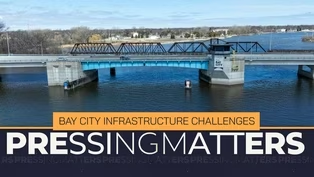
Pressing Matters | Bay City Infrastructure Challenges
Video has Audio Description
Clip: S3 Ep2 | 6m 19s | The driving challenges facing people and businesses in Bay City. (6m 19s)
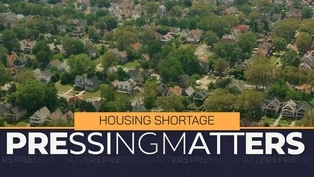
Pressing Matters | Housing Shortage
Video has Audio Description
Clip: S3 Ep2 | 9m 23s | Pressing Matters dives into the housing shortage in Michigan. (9m 23s)
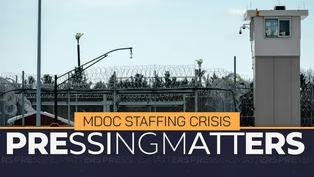
Pressing Matters | MDOC Staffing Crisis
Video has Audio Description
Clip: S3 Ep2 | 10m 28s | Pressing Matters examines Michigan’s prison system and the crisis level staffing shortage. (10m 28s)
Providing Support for PBS.org
Learn Moreabout PBS online sponsorship New Episode
- News and Public Affairs

Top journalists deliver compelling original analysis of the hour's headlines.

- News and Public Affairs

FRONTLINE is investigative journalism that questions, explains and changes our world.
 New Episode
 New Episode
 New Episode
 New Episode
 New Episode

 New Episode


Support for PBS provided by:
Pressing Matters is a local public television program presented by WCMU